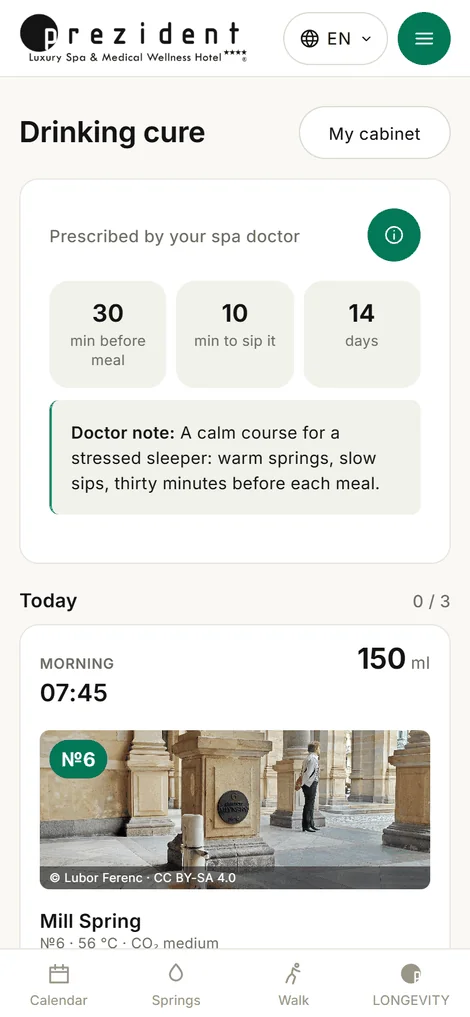
The model is the spa doctor's paper card: three columns — morning, midday, evening — each with millilitres and a spring number, plus «N minutes before the meal» and «sip it over N minutes». The screen is built from that, not from a developer's idea of how water is drunk.
Hence its main property: every serving has its own spring. A cure of six servings may walk three different vases, and the portal counts what you drank into the serving you pressed, not into the next one in order.
What is on a serving card
The part of day, the time, the volume in large type, a circle with the official spring number, a photograph of the vase, a small map and a «Route» button. Above them the prescription tiles: how many minutes before the meal, how long to sip, how many days the cure runs, and the doctor's note if they left one.
Tying it to meals is optional: a prescription has four settings — before, after, with, and «not tied to a meal». The last two print no minutes at all.
A serving: time, volume, spring number, photograph and the way to the vase×
The spring number is not decoration
The doctor writes a number on the card, and it has to match the plate on the vase. The town's official numbers are covered in full, from №1 to №12 (fourteen records: the Vřídlo has three outlets).
These numbers were once out by one — the Mlýnský stood as seventh instead of sixth — and a card saying «№6» found nothing. An automatic check holds them now: a correction «by eye» here costs a guest a walk.
Every vase has its own point on the map rather than the colonnade's: the Skalní stands at the end of the 130-metre Mlýnská colonnade, and the difference is seventy-three metres.
«Drunk», and sixty metres
A serving is confirmed if the phone sees you within sixty metres of the spring. The radius used to be larger, and with it a serving was confirmed at any vase at all: the Mlýnský to the Rusalka is 26 metres.
Sixty separates the colonnades (the Vřídlo is 234 metres away), but no phone tells apart two springs twenty-six metres from each other, and the portal does not promise that it does.
When the guest picks the spring
The doctor can let you choose the spring yourself, with a switch in the prescription. The time, the volume, the distance from the meal and the sipping stay the doctor's; the vase is yours, chosen with «Pick a spring»: a sheet with all fourteen, their numbers, temperatures, CO₂ content and effect.
Under a substituted spring stands the line «The doctor prescribed №N» — a patient does not rewrite a doctor's card. On the round such a serving's number is gold, so the doctor can see where the choice was yours.
Repeating a previous cure
You have come back and know the cure by heart — the «Copy to myself» button copies the previous cure's schedule and starts it today. The schedule is copied, not the history of servings.
The copy is marked: on the round the doctor sees a badge saying «the guest repeated it themselves» and puts it out with their own prescription, like any earlier one. The reason is simple: waiting for an appointment costs a week of a three-week cure.
Editing a cure is a new prescription. The previous one is put out, the new one starts today, and the «Day N» counter goes back to one. It always worked that way; now it is written in words above the doctor's button.
How this works for a person
At 07:30 the phone says: 200 ml from spring six, twenty minutes before breakfast, sipped over ten. You open the card, press «Route», walk to the vase, drink and mark the serving. The watch shows the same thing on your wrist (how).
The demonstration page `#/springs/demo` is open without signing in: it shows what this looks like and writes nothing.
What reception does
The cure is prescribed by the doctor, not the desk. But it is the desk that explains on the first day where the water lives in the phone, and it is the desk's board that shows who has no cure yet.