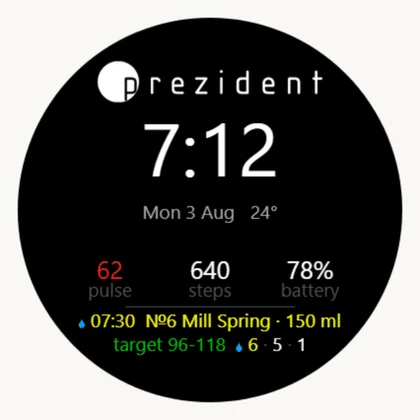
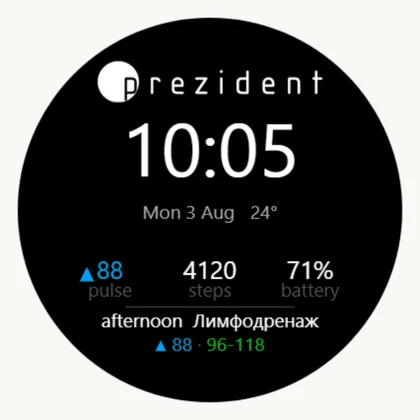
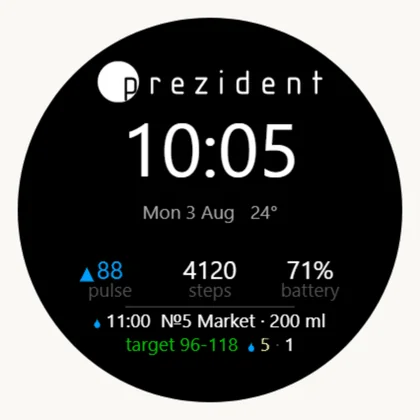
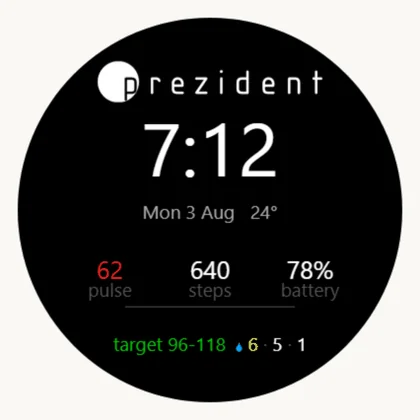
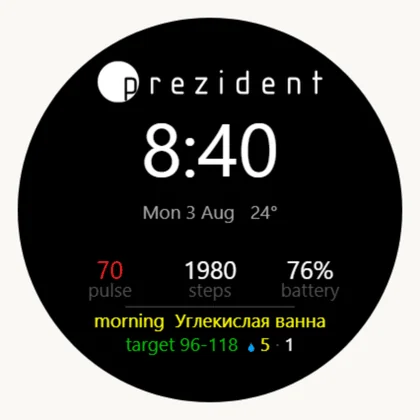
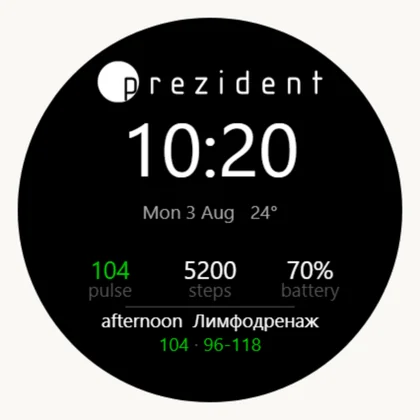
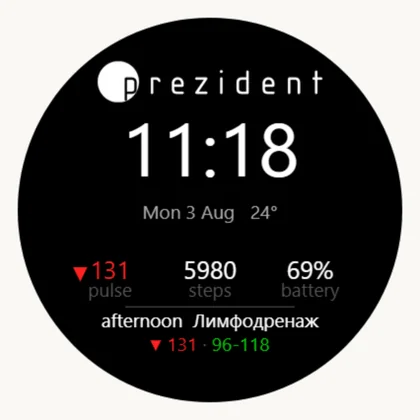
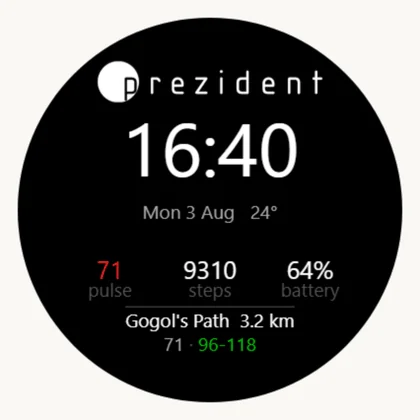
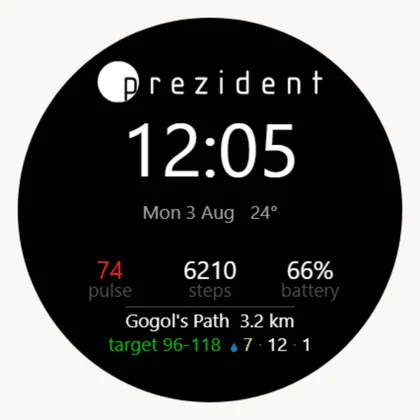
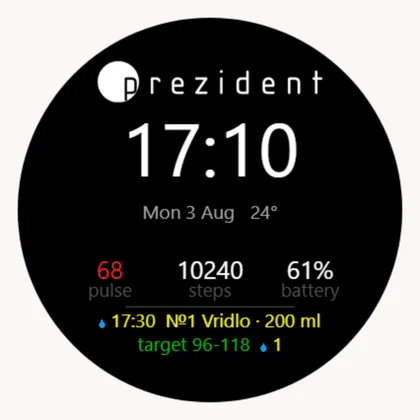
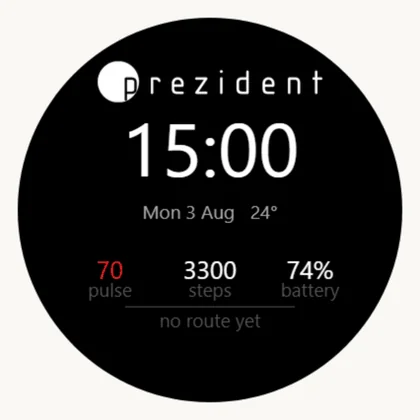
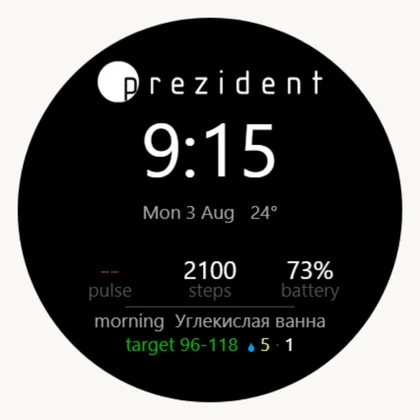
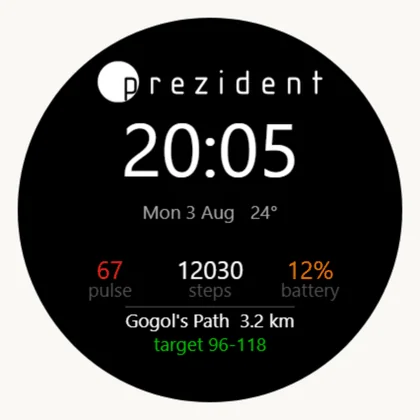
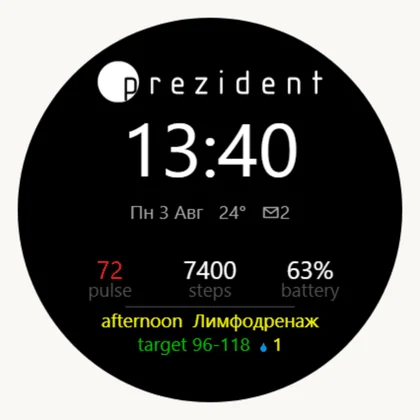
A serving due in 18 minutes: the carousel holds it and blinks — Garmin gives a watch face no vibration×Pulse below the corridor: blue arrow up, corridor beside it×
Top to bottom
Element
What it means
Where it comes from
The hotel's mark
A fixed mark at the top.
app resource
Time
Hours and minutes, 12- or 24-hour as the watch is set.
the watch
Date
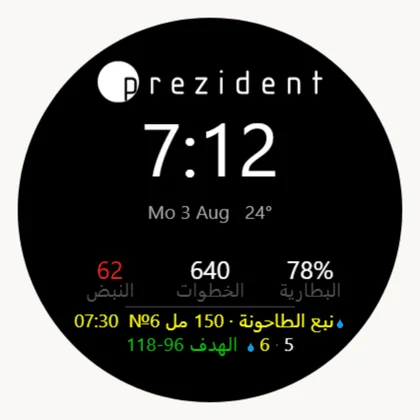
Weekday, day and month — in the guest's language: the portal sends the names along with the rest of the words. It falls back to the firmware, in the watch's own language, in two cases: Arabic and Hebrew (only Garmin itself reverses that line correctly) and for the first half hour after midnight, until the face fetches the new day.
the portal, else the watch
Temperature
Outside, right now, in the watch's own units. No forecast on the phone, no figure.
Garmin Weather via the phone
✉ N
Unread phone notifications. A watch face is given the count and nothing else — but without it ours would be the one face showing no trace of a message at all.
the watch
Pulse
Current, beats per minute. A dash means the sensor caught nothing.
optical sensor
The arrow
Appears only while the guest is walking: up to go faster, down to ease off. Inside the corridor there is no arrow.
the corridor and the walking test
Pulse colour
Red — no verdict (not walking); blue — below the corridor; green — inside; red — above.
the same
Steps
Today's count.
the pedometer
Battery
Percent; orange below 20%.
the watch
The event line
One event at a time, turning over every three seconds: the cure's servings (exact time, spring, volume) and the day's procedures (a slot, because the plan holds no hour for them). The last card of the round is the route itself.
the portal
Its colours
Yellow — within half an hour; white — still ahead; grey with a tick — already drunk. Anything past never enters the round.
—
The drop
The drinking cure's mark, the same in the app and on the glance.
—
The bottom line
Blinks between two beats of three seconds — see below.
the portal and the sensor
The bottom line: two beats
Beat
What it shows
Why
First
«target 96-118», the drop, and the numbers of the springs still to be drunk.
The whole day on one line and in no language at all: yellow is next, white is ahead.
Second
«88 · 96-118» with an arrow: the same pulse that burns above the rule, set right beside the corridor.
The corridor alone is half an answer: the guest saw «96-118» below and a red «88» above and did not join the two.
The same moment, second beat: the target and the spring numbers×Pulse below the corridor: blue arrow up, corridor beside it×
The words «a little faster» and «ease off» are gone from the face: in thirty-six languages they were written at thirty-six widths, pushed the cure's numbers off the line, and said exactly what the arrow says.
Where the corridor comes from
The portal works it out from the guest, not from the route, so it exists from day one and without any walk assigned. The formula is a share of (220 − age), and the share follows the risk level from the quiz.
Risk level
Lower bound
Upper
very low
75%
85%
low
70%
80%
increased
60%
70%
high and very high
50%
60%
The real age is used — from the date of birth written at the desk — provided it does not contradict the age band from the quiz; otherwise the band's midpoint stands. Example: a guest of 49 at very low risk, 220 − 49 = 171, corridor 128–145.
The corridor is priced on walking. A pulse of 89 at rest against a target of 128–145 is not a deviation: 89 is what is happening now, 128–145 is what a walk should reach. That is why the arrow stays silent until the guest is actually moving — telling somebody at breakfast to speed up is bad advice.
Why one should walk inside the corridor at all, and what to do about the figure, is the article «The pulse corridor»; this one only says where the number comes from and how it reaches the glass.
The sleeping screen
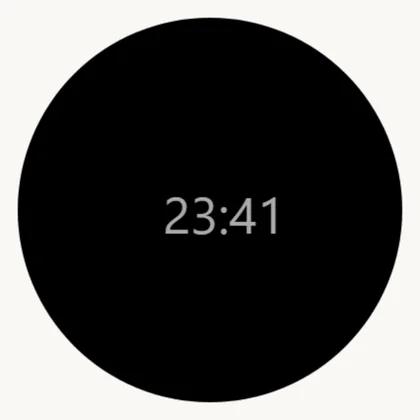
With the wrist down the face draws the time alone, thin, without the mark or the date, and shifts it a couple of pixels every minute. The screen is AMOLED: the system watches for burn-in and takes down a face that lights more than a tenth of the pixels while asleep or holds one pixel longer than three minutes.
Not to be confused with Garmin's own night mode: inside the sleep window that one replaces the face entirely — hollow digits with an alarm line — and on a hotel watch it is switched off when the kit is set up: Setting up the kit.
Wrist down: the time alone, drifting a few pixels a minute×
Every state
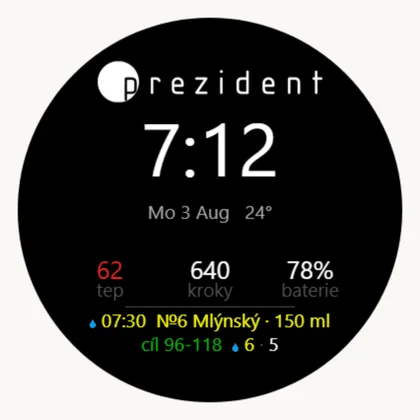
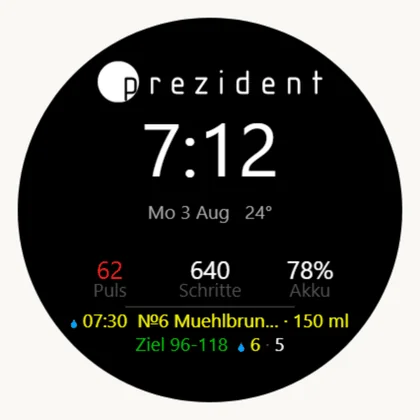
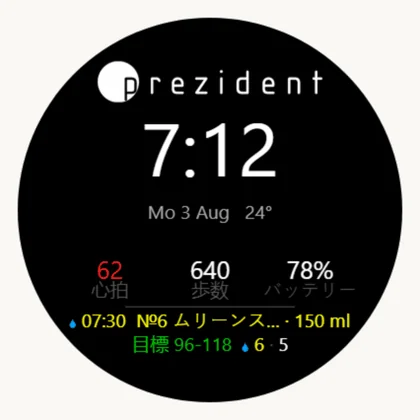
Every screen a guest can meet. The shots are drawn from the watch's own code, not photographed.
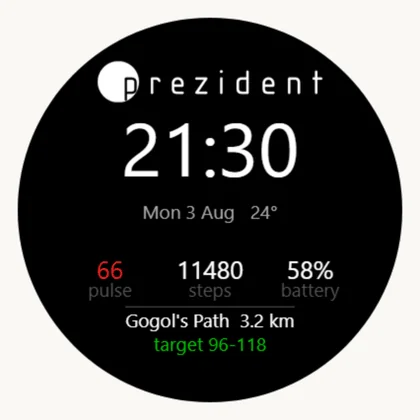
A serving due in 18 minutes: the carousel holds it and blinks — Garmin gives a watch face no vibration×The dark half of that blink×A procedure: a slot instead of a clock time, because the plan has no exact hour for it×Pulse below the corridor: blue arrow up, corridor beside it×The same moment, second beat: the target and the spring numbers×Pulse inside the corridor: green, no arrow×Pulse above the corridor: red arrow down×The carousel reached the route's own card×Six servings in a day — the longest row of numbers there is×Evening: one serving left, the row has shrunk to it×The day is over: only the route stays in the round×No quiz taken: no route, no day, no corridor×The sensor caught nothing — a dash, not the last known figure×Below 20%: the figure turns orange×Unread phone notifications — ✉2 in the date line×Wrist down: the time alone, drifting a few pixels a minute×Czech — the language of the house×German writes longest of all×Japanese: a different glyph set×Arabic: the line reads right to left, the drop moves right×
Two languages, not one
On the wrist the guest's language meets the watch's language, and they are different things. Confusing them is behind nearly every question about language.
The guest's language
The watch's language
Set where
in the portal: the «Language» field on the issue form, then by the guest in their cabinet
on the watch: Settings → System → Language
Written in it
everything of ours: the «pulse / steps / battery» labels, the day's events, the names of springs and procedures, the app's own words and, since 07.08.2026, the date line
every screen belonging to Garmin: menus, settings, notifications, the stock glances
Changed by
the guest or the staff, at any time
the desk, by hand, usually once
The words arrive from the portal — the watch carries neither the catalogue of procedures nor the names of the springs, the server writes the sentences in the guest's language. So a language changed in the cabinet shows on the watch without a reinstall and without the desk: the app picks it up the next time it opens, the face within half an hour, when it next fetches the day.
A watch cannot draw every alphabet: Chinese, Japanese, Korean and Thai live in separate font sets, while Latin, Cyrillic, Greek, Hebrew and Arabic share one. So the watch tells the portal what it can draw and the portal answers in a language that will be legible. For those four — and only those — the desk has to set the language on the watch itself: how and when.
The Garmin account does not carry the language. The portal writes only the guest's body into the kit's account — sex, birth year, height, weight, wrist — because Garmin prices calories and zones from those. Language is not in that record: our screens take it from the portal, Garmin's own read the watch's setting.