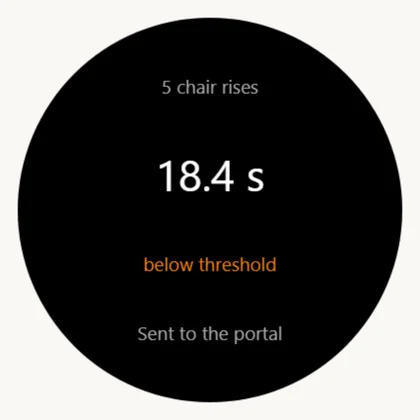
Four short tests that geriatrics uses to measure not disease but function: will this person stay on their feet, is there strength to rise from a chair, how far do they walk in six minutes. They are taken at the start of a stay and before departure, and the final sheet compares exactly those two pairs.
Three are taken by the watch. The fourth — grip strength — needs a dynamometer and is typed in by a nurse.
Test
What the guest does
Threshold
Evidence
6-minute walk
Walks six minutes at their own pace; the watch counts metres.
under 288 m low, from 360 m good
Ross 2010; 288 m is 0.8 m/s, 360 m is 1.0 m/s
5 chair stands
Rises and sits five times, arms crossed.
over 15 s low, under 10 s good
EWGSOP2 2019: five rises in over 15 s = low strength
One-leg stand
Stands on one leg as long as they hold.
under 10 s low, from 30 s good
Araujo 2022: failing 10 s carried HR 1.84
Grip strength
Squeezes a dynamometer.
by sex and age
typed in; no watch can do this
Eight steps on the watch
The screens are real — drawn from the watch's own code. Buttons: START top right, BACK bottom right, UP and DOWN on the left.
The screen takes touch, so every step has a second road: the menu scrolls and selects by finger, pages are swiped. For the tests themselves stay on the buttons — during the five stands the wrist is against the chest, and reaching for the glass during a one-leg stand is how balance is lost early.
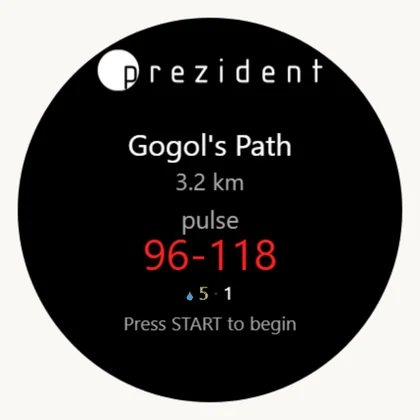
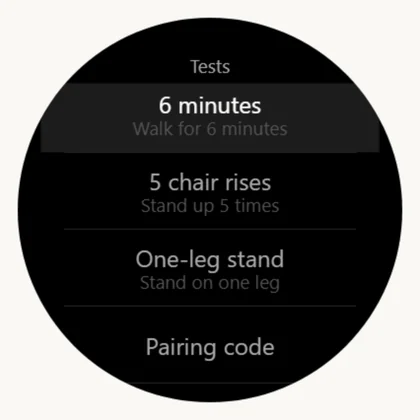
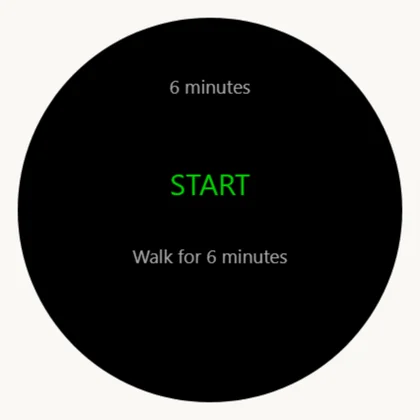
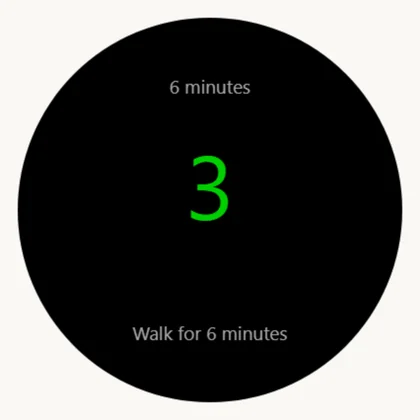
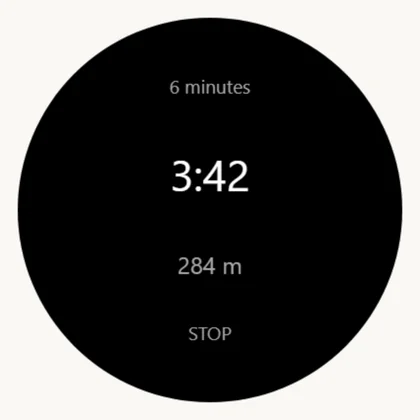
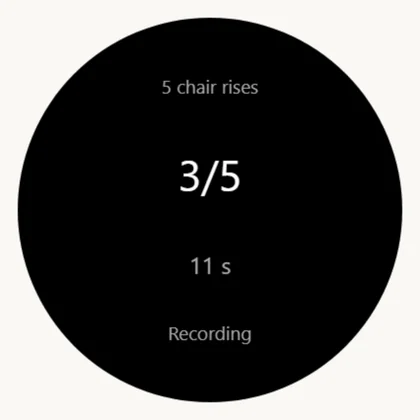
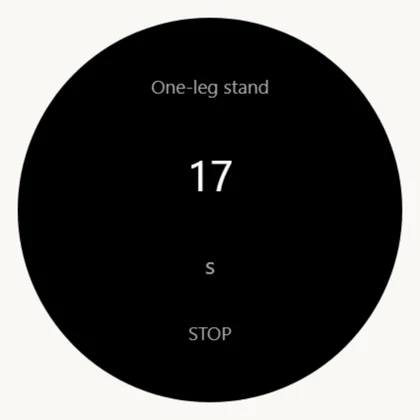
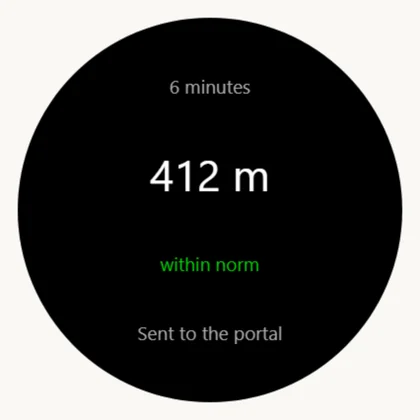
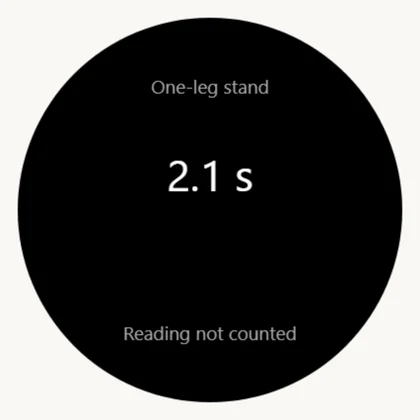
1. START on the face → «Longevity Prezident Walk» in the activity list. The idle screen opens×2. Hold UP. The menu: three tests and the code. UP/DOWN to choose, START to open×3. The test screen: which one at the top, START in the middle, what to do at the bottom×4. START → a 3-second countdown, each second buzzed: time to stand up, fold the arms, lift a foot×5a. «6 minutes»: time left and metres covered. A buzz at the halfway mark×5b. «5 stands»: the watch counts the rises itself, but STOP always wins over the counter×5c. «One-leg stand»: seconds. It never stops by itself — whoever is next to the guest presses STOP×6. STOP → the result on screen and «Sent to the portal» below×7. Below the threshold — an orange line. Not a diagnosis: a reason to add a procedure×8. «Reading not counted» — a finger slipped. BACK, START again, nothing is lost×
How the three differ
Test
Who stops it
On screen
6 minutes
The watch, at 360 seconds exactly. A buzz at the halfway mark.
time left and metres
5 stands
The watch on the fifth rise — but STOP always wins over the counter: the rises are counted from the accelerometer, which is an assist, not a judge.
the rise counter and seconds
One-leg stand
A person only. The watch cannot tell a stumble from a wrist movement, and stopping a second early ruins the reading.
seconds
After STOP
The result reaches the portal at once and comes back banded three ways: within norm, good, below threshold in orange. Three and not five: a five-point scale would imply a precision these tests do not have.
With no phone nearby it queues and travels by itself, like a walk. «Reading not counted» means the value is too small to be a measurement — a slipped finger, better not recorded at all.
What the doctor does with it
The result lands on the same morning sheet as the night. Below threshold, the sheet proposes adding a procedure rather than treatment. The thresholds are an article of their own.
The guest sees their own results in the cabinet, under «Functional tests», next to the previous reading.