Military personnel recovery: programme 09, 14 days
A spa course for combatants and people in extreme occupations: 14 days by default, 7 at least. It lifts nervous exhaustion and unloads the musculoskeletal system.
What it is. Military personnel recovery is the ninth of the platform's ten longevity programmes: a spa course for combatants and people in extreme occupations. The default stay is 14 days, the shortest one 7.
Two jobs at once. The course is Deep Recovery folded into Joints & Mobility: one half works on an exhausted nervous system — hypervigilance, short sleep, chronic strain — the other on a musculoskeletal system worn by static, impact and weight-bearing loads.
The core. Eight entries: floating (3 times a week), magnetotherapy (3), therapeutic massage (3), peat mud packs (3), oxygen therapy (2), the fitness centre (3), guided Nordic walking (3) and the pool (4).
The evening sleep protocol. Attached to the course in full, the way Deep Recovery carries it: six rules for the evening, from a quiet walk after dinner to the same bedtime every day.
What it is measured by. Seven markers from the Garmin Forerunner 165 Music watch: HRV (heart rate variability), sleep score, daily stress, Body Battery, readiness for the day, VO₂max and fitness age.
What the night does. HRV 15 % below the guest's own baseline, a sleep score under 60 out of 100 or Body Battery under 40 — the portal takes the included heat out of the day and shortens the walk by 30 %, but never below 20 minutes. Paid procedures are proposed to the doctor rather than changed silently.
Metal in the body. A quiz tick for a pacemaker, fragments, plates or joint implants closes magnetotherapy and andullation outright; the hydrojet bed, oxygen therapy and floating take their place.
Who this text is for. The spa physician and the spa coordinator: it is a handbook to the guest's screen, not a sales sheet. Updated 22.08.2026.
Build the programme in the portalThe demo portal opens on the programme shelf, with the Service Members Recovery tile and a two-minute quiz.
Who the course is prescribed to
The course is built for a load that was never sporting and never chosen: long static positions under the weight of kit, impact and vibration, short and broken sleep, constant alertness. That life is not only a combatant's — rescue workers, firefighters, mine rescuers and shift crews arrive with the same thing. In the portal's quiz it is the goal «recovery under chronic strain»; on the programme shelf the tile reads Service Members Recovery.
The course does not treat post-traumatic stress disorder and replaces neither psychiatric nor surgical care. It does what a spa can do: bring sleep back, take muscle hypertonus and periarticular swelling down, return tolerance to load. Everything medical in it is signed by the doctor at the day-1 examination, and 27 entries in the catalogue are closed to self-booking altogether — only a doctor prescribes those.
A shorter stay is assembled too, but the plan marks the course as cut short. The mid-stay consultation appears from 10 days, the blood panel from 7, the closing consultation from 5: on a three-day stay there would be nothing to compare.
The seven markers the course runs on
Five markers come off the watch: four from the night and the day (HRV, sleep score, daily stress, Body Battery), and the fifth — readiness for today — the platform works out itself from those four and the resting pulse. The sixth and seventh, VO₂max and fitness age, are computed from recorded walks, so they appear once there is history rather than on day one. The thresholds below are the shipped ones; the doctor moves them in the panel, and from the next morning the sheet counts by the new numbers.
Marker
What it shows
When the platform steps in
Where it comes from
HRV (heart rate variability)
the night's vagal tone: under continuous sympathetic drive it stays suppressed
a night 15 % below the guest's own average
the watch, overnight recording
Sleep score
continuity of sleep and the share of deep and REM phases
a score under 60 out of 100, or sleep shorter than 6 hours
the watch, overnight recording
Daily stress
how hard the autonomic system works through the day, read from beat-to-beat intervals
a daily average above 50 out of 100
the watch, all day
Body Battery
the reserve: it fills overnight and is spent through the day
a daytime low under 40 out of 100
the watch, all day
Readiness for the day
five components in one figure: Body Battery (weight 30), HRV (25), sleep (25), resting pulse (10), yesterday's load (10)
under 50 out of 100 — a rest day, and the doctor decides; above 75 the day goes as planned
the platform works it out from the night
VO₂max (estimate)
the aerobic reserve: how much oxygen the body manages to take up under load
no threshold: the trend is what is read, the estimate carries about 5 ml/kg/min of error
computed from walks
Fitness age
the same reserve translated into years and set beside the age on the passport
no threshold: the distance from the real age and its direction are what matter
computed from walks and the quiz
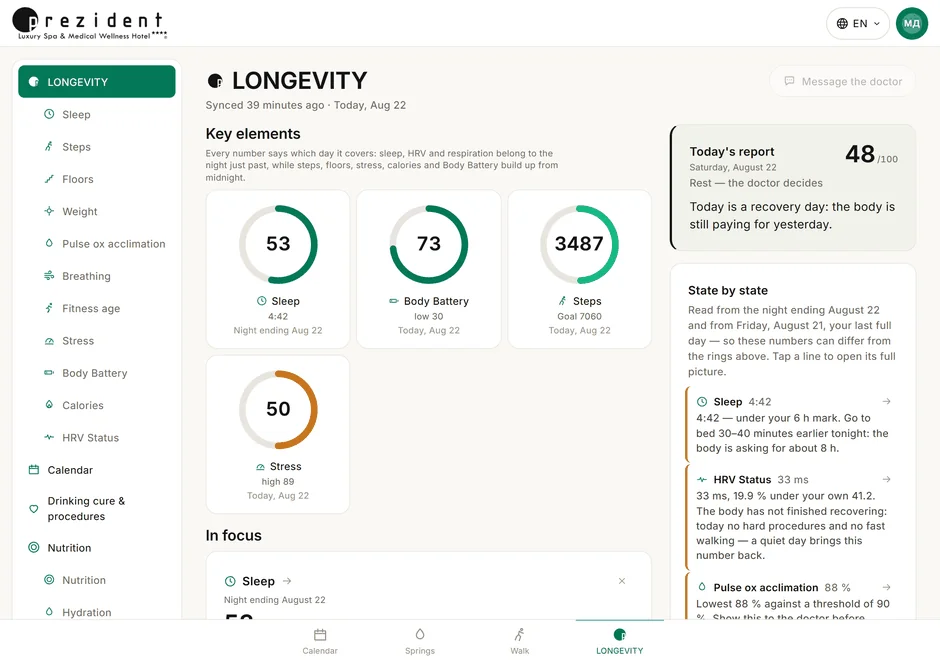
The guest's first page in a browser window: four rings for the day and today's report with a readiness of 48 out of 100. The demo guest slept 4:42 for a score of 53, Body Battery fell to 30 by morning, and daytime stress reached 89×
The guest's screen, read by the doctor
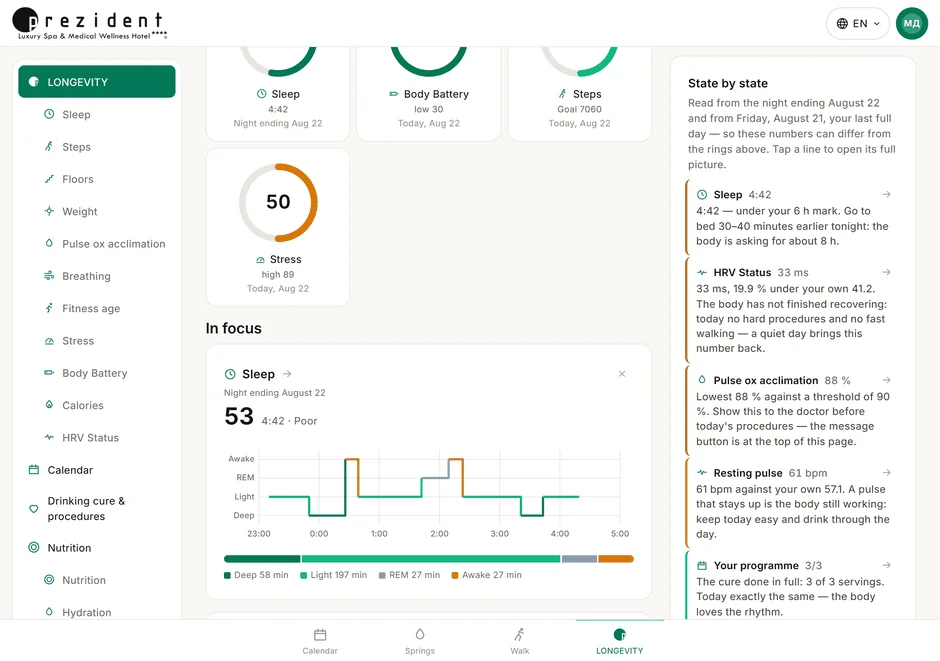
The state-by-state breakdown to the right of the rings is where the morning round starts. Every line compares last night not with a textbook but with this guest's own average for the stay: the demo guest's HRV is 33 ms against her own 41.2, a fall of 19.9 % where the threshold is 15 %, and the line already says in words that there should be no hard procedures and no fast walking today.
Two more figures sit beside it, and in this programme they are always read. A resting pulse of 61 bpm against her own 57.1 — the body is still working; a lowest blood-oxygen reading of 88 % against a threshold of 90 % — the line asks outright that the doctor sees it before today's procedures. Neither figure cancels anything on its own: they gather into the morning sheet, and a person decides.
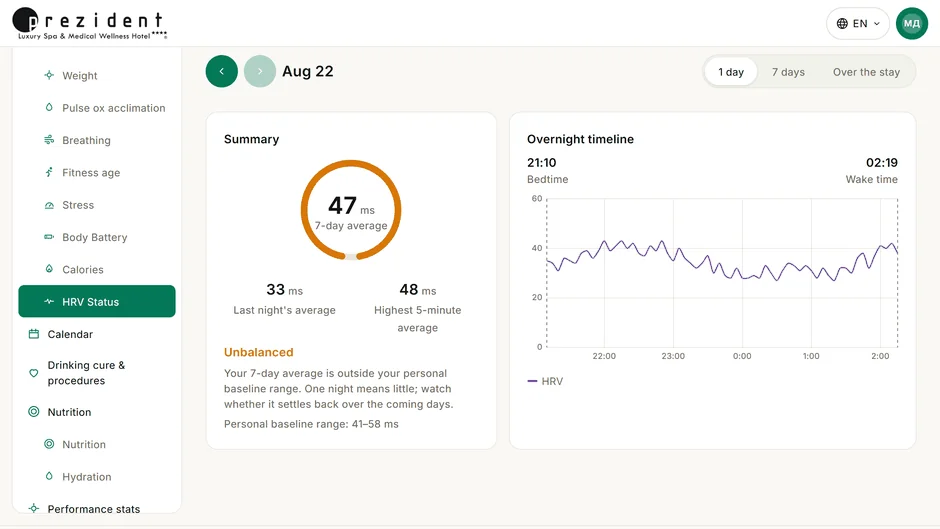
The HRV Status room shows the same thing in more detail: a range, not a point. The guest's personal range is 41–58 ms, the seven-day average has left it downwards, and the status reads Unbalanced. One night proves nothing; on a 14-day course what matters is whether the average returns into the range by mid-stay.
The state-by-state breakdown: sleep 4:42, HRV 33 ms against her own 41.2, lowest SpO₂ 88 % against a threshold of 90 %, resting pulse 61 bpm against 57.1. On the left, the night's hypnogram: 58 minutes of deep sleep, 27 of REM×The HRV Status room: last night's 33 ms, a seven-day average of 47 ms and a personal range of 41–58 ms. The night's curve is drawn in five-minute windows from lights out at 21:10 to waking at 02:19×
Sleep and the evening protocol
Sleep is a working instrument here, not a pleasant extra: the deep phase is when growth hormone is released overnight and ligaments and muscle are repaired, and the REM phase is when the day just lived is processed. In a person whose adaptation is disturbed, sleep is broken and shallow, and daytime procedures alone do not mend it. So the platform attaches the evening protocol to the course — the same one Deep Recovery carries, and for the same reason.
The protocol is printed inside the stay plan as six lines and is discussed at the day-1 examination alongside the procedures:
A quiet walk after dinner.
No coffee or strong tea after 14:00.
The last drink two hours before bed.
A cool, dark, quiet room.
No screens for an hour before sleep.
The same bedtime every day, including the day of arrival.
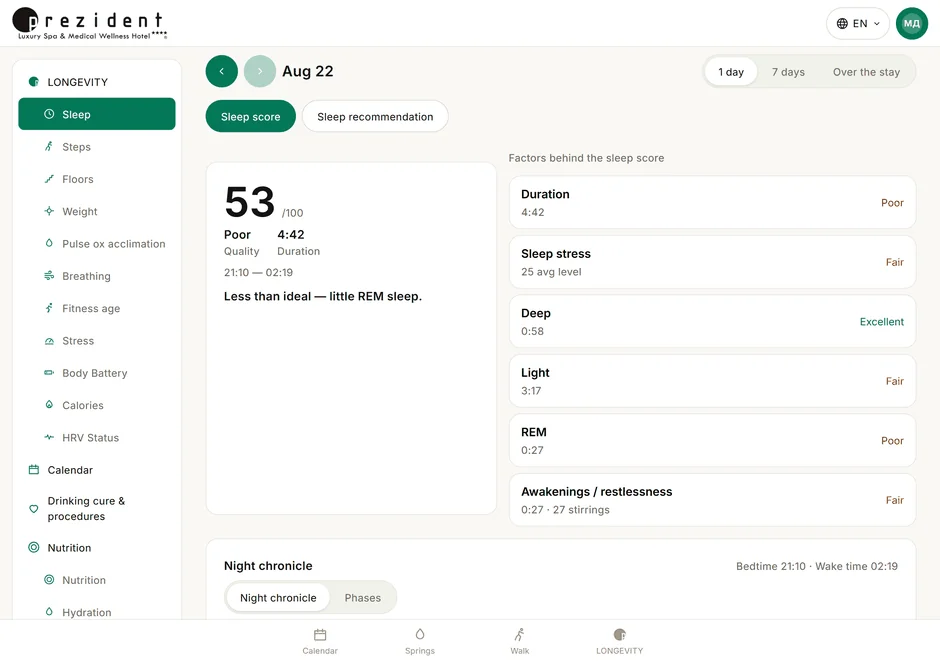
The Sleep room for the night: a score of 53 out of 100, a duration of 4:42 and the factors behind it — deep phase 0:58 (excellent), REM 0:27 (poor), 27 awakenings and stirrings. A score under 60 is the threshold at which the morning sheet advises the evening protocol×
Physical reserve: readiness, VO₂max and fitness age
The other half of the course is about what the body can carry today. The platform works readiness out of the night: Body Battery is worth 30 points of weight, HRV 25, sleep 25, resting pulse 10 and yesterday's load 10. Above 75 the day runs as planned, between 50 and 75 the walk is easier and the hard entries are in question, below 50 it is a rest day and the doctor decides it. The demo guest is at 48, and the portal says it plainly: «Rest — the doctor decides».
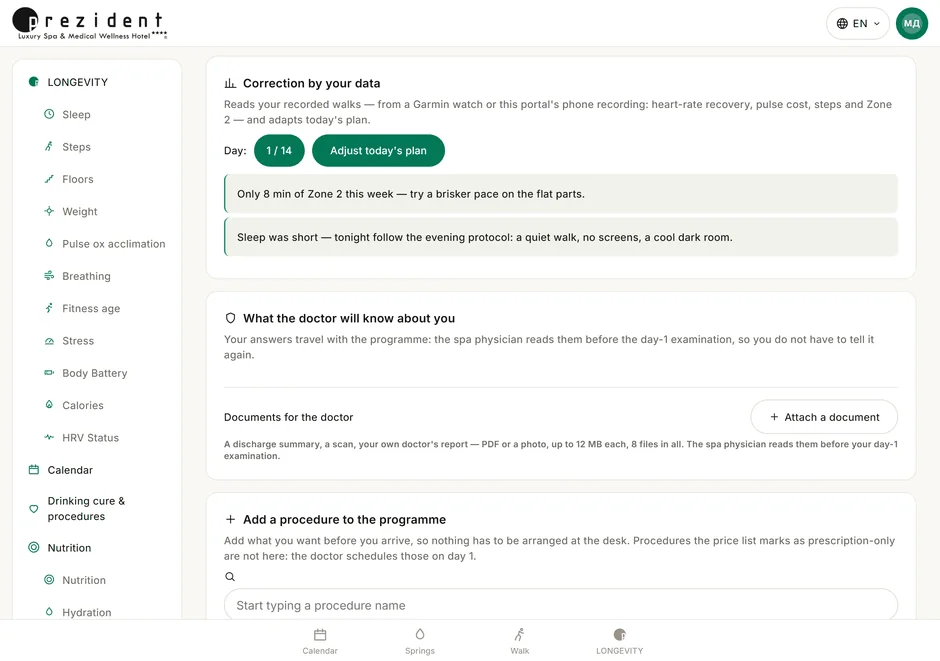
VO₂max and fitness age are computed not from the night but from walks: from pace, climb and heart rate. Their job in this programme is to keep the load inside the restorative second heart-rate zone, the pace where you can talk but not sing. The weekly mark for zone 2 is 150 minutes; the demo guest gathered 8 over her week, and the portal proposes not a harder workout but a brisker step on the flat parts.
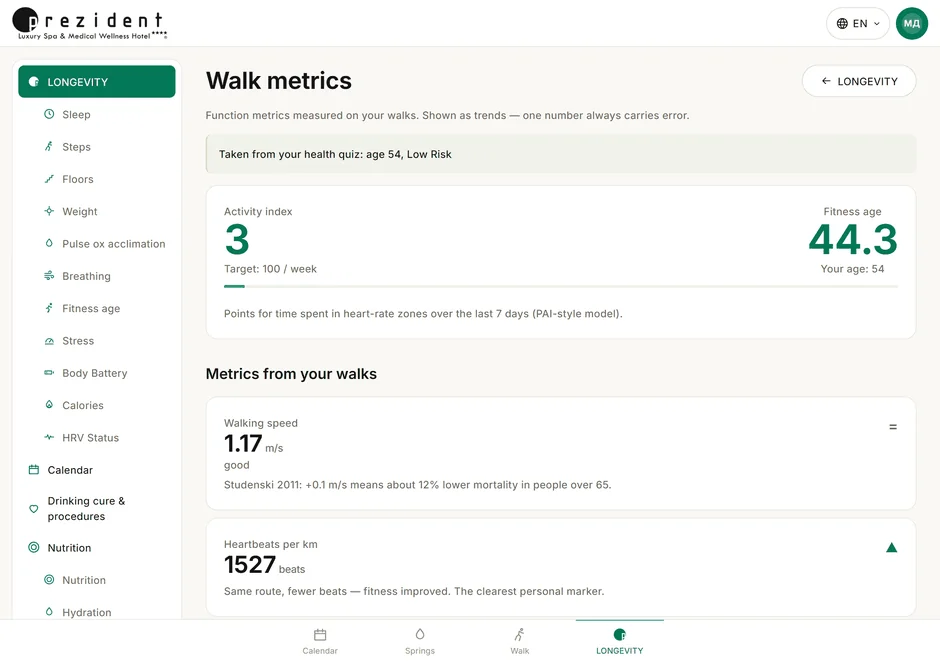
Two more walking metrics sit next to them and matter here. A walking speed of 1.17 m/s is a survival marker with a plain price per division (plus 0.1 m/s is about 12 % less risk in people over 65), and heartbeats per kilometre is the most honest personal figure of all: the same route with fewer beats means the route has become cheaper for the heart.
Walk metrics: a fitness age of 44.3 against a real 54, an activity index of 3 out of a weekly 100, a walking speed of 1.17 m/s and 1527 heartbeats per kilometre. Further down the same screen are zone 2 for the week and the VO₂max estimate×
The medical frame of the course
The frame is the set of days put there by the medicine of the stay rather than by the procedure quota. It is the same for every spa course on the platform, with one difference here: the blood panel looks at inflammation and the traces of muscle breakdown, and a vascular ultrasound is offered as a module — legs carrying kit wear out first.
When
What stands there
Why
Day 1
medical examination and the drinking-cure prescription; an ECG for a guest over 60
the plan out of the portal is a draft, and the doctor signs it; contraindications from the quiz are confirmed here
Day 2 (stays from 7 days)
blood laboratory panel; an InBody body-composition measurement on stays from 10 days
the starting point: inflammation, electrolytes, muscle mass — what the end of the stay is compared against
Mid-stay (from 10 days)
an interim doctor's consultation
this is where the course is corrected by the nights gathered so far, not by how one day felt
The day before departure
a repeat InBody measurement
so the closing consultation has two measurements to compare instead of one
The last day (stays from 5 days)
the closing doctor's consultation
the guest leaves with a before-and-after rather than with an impression
The core: eight procedures
The core is what the algorithm fills the days with first. The frequencies below are weekly: on a 14-day stay each entry stands roughly twice as often. The plan keeps a day between two sessions of the same procedure, and never puts more than one demanding entry into a day — that is the classic spa rhythm, not a limitation of this programme.
Procedure
Times a week
Length
What it does in this course
Floating
3
60 minutes
weightlessness in Epsom salt takes the axial load off the spine and removes outside stimuli; of the whole core this is the most direct work on anxious alertness
Magnetotherapy
3
15 minutes
anti-oedema and regenerative work on joints and nerve trunks; prescribed by the doctor and closed when there is metal in the body
Therapeutic massage
3
60 minutes
targeted work on spasmed paravertebral muscles and myofascial blocks
Peat mud pack
3
20 minutes
deep warming of ligaments and joints, resolution of periarticular swelling; it is a heat procedure, and the night loop looks at it first
Oxygen therapy
2
50 minutes
work on tissue and cerebral hypoxia: fatigue, a heavy head, slow recovery after load
Fitness centre
3
60 minutes
gentle joint gymnastics and the deep stabilising muscles under an instructor; included in the stay
Guided Nordic walking
3
60 minutes
cyclic aerobic work with the knees unloaded onto the poles; held inside the second heart-rate zone
Swimming pool
4
60 minutes
full gravitational unloading of the musculoskeletal system in warm water; included in the stay
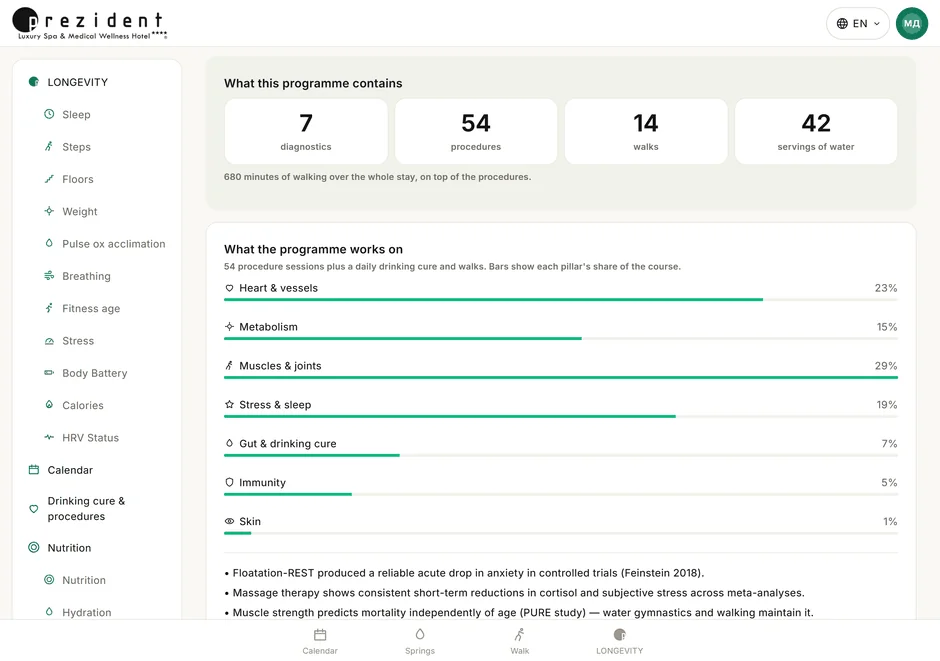
The programme screen in the portal: a 14-day stay in figures — 7 diagnostic entries, 54 procedure sessions, 14 walks and 42 servings of water. The bars show the share of each of the seven pillars: muscles and joints 29 %, heart 23 %, stress and sleep 19 %×
The extras of the course
Extras are laid on top of the core when a day still has slots left: how many there are is set by the budget level the guest picked — from two to four entries a day. Half of this list is what the night loop swaps demanding work for when a night has gone badly.
Procedure
Times a week
Why it is in this course
Dry CO₂ bath
3
vascular work without loading the heart: the gas acts through the skin and no water touches the body
Hydrojet massage bed
2
a contact-free water massage of the back; permitted with metal in the body, so it often takes magnetotherapy's place
Sauna world (bio, Finnish, salt, steam)
2
included in the stay and open in the evening; after a bad night it is the first thing taken out
Andullation therapy
2
gentle mechanical vibration along the spine before the evening; closed when there is metal in the body
H₂ hydrogen therapy
2
the antioxidant part of the course, scheduled next to oxygen on the heavier days
Classical massage
2
short, gentle work on days when the therapeutic massage stood the day before
How the procedures bring the markers back
The link runs one way and explains itself: the platform promises no figure, it shows what it put into the plan and why. Every edit is signed with its cause — the walking trend, the night or a functional test; an edit that cannot be explained by a number never reaches the plan.
What the data shows
What goes into the plan
Why it works
HRV below the guest's own baseline, daily stress staying high
floating, magnetotherapy, dry CO₂ baths
the absence of outside stimuli and a warm magnesium bath let the parasympathetic side take over; the work happens without loading the heart
A sleep score under 60, a broken night
the evening protocol, andullation, the hydrojet bed
gentle vibration and the release of paravertebral muscles lower spinal reflex excitability, and a fixed bedtime brings the rhythm back
Body Battery not recovering overnight, readiness falling
oxygen therapy, H₂ hydrogen therapy, the drinking cure
work on tissue hypoxia and the water-salt balance takes away part of the systemic fatigue; the load does not grow that day
Pain and stiffness, muscle hypertonus
peat mud packs, therapeutic massage, the pool
warming and targeted muscle work return the range of painless movement, and water takes the body's weight off the joints
Fitness age above the real one, zone 2 not accumulating
Nordic walking, the fitness centre
measured cyclic work in the aerobic zone builds volume rather than speed: the joints take no extra impact
Day by day: what the plan looks like
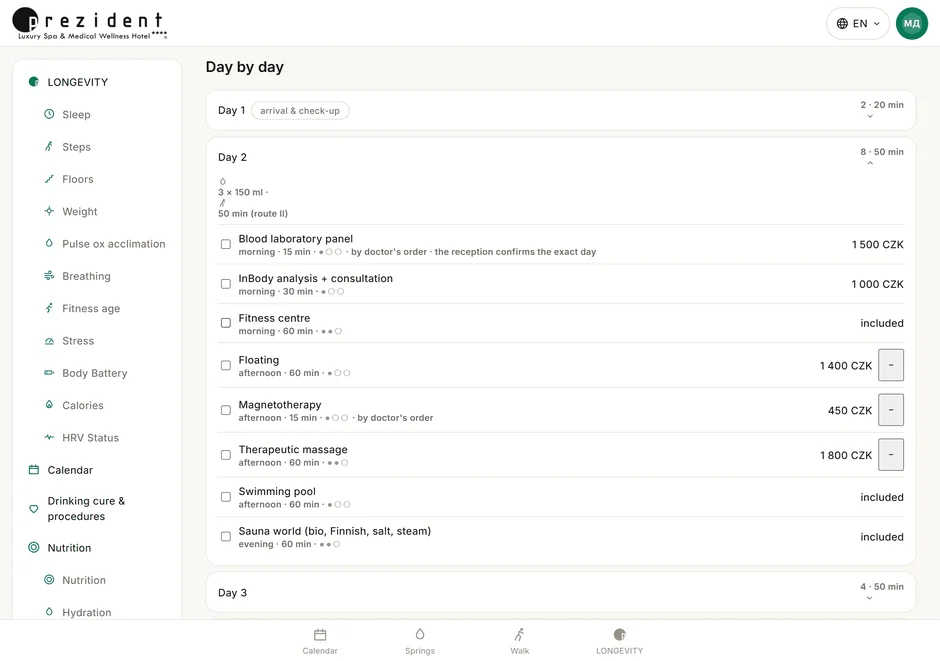
The example below is a 14-day stay at a standard pace and the comfort level: 7 diagnostic entries, 54 procedure sessions, 14 walks totalling 680 minutes and 42 servings of 150 ml of water. Day one is medical, every seventh day is a lighter one, and every entry carries its slot (morning, afternoon, evening), its length and its price from the hotel's list.
There are almost no evening procedures in the plan, and that is not an omission: the treatment rooms work from 09:00 to 12:00 and from 12:30 to 16:00, on Sunday mornings only. The evening belongs to the saunas and the pool — the things that need no staff. The blood-draw day is put in a sensible place but labelled honestly: the exact day is set by reception, because the nurse works a short-week and long-week rota.
Day 2 of the stay expanded: the laboratory panel and InBody in the morning, the fitness centre, floating, magnetotherapy and therapeutic massage in the afternoon, the saunas in the evening. Above the day — 3 servings of 150 ml of water and a 50-minute walk on route II×
The night loop: what the portal changes by itself
The night loop never runs before 06:00: the watch fleet syncs on a half-hour circle, and a correction made at six on an empty night would have cancelled the sauna for somebody who is merely still asleep. By the morning round the sheet is ready.
The owner drew the line of authority: what is free and ours the portal corrects itself, paid procedures are changed by the doctor. For this programme that matters more than for most: half of the core is paid work, and a therapeutic massage removed in silence would be a loss for the guest and for the hotel alike.
What counts as strain. A resting pulse 5 bpm above the guest's own average, HRV 15 % below it, a sleep score under 60, sleep shorter than 6 hours, daily stress above 50, Body Battery under 40, a day's load 50 % above the guest's own. Three days in a row of the same thing raises a separate flag: it proposes reviewing the whole programme.
Heat procedures. A sauna included in the stay is taken out of today without asking — it is free, and the guest puts it back with a button.
The walk. Shortened by 30 %, but never below 20 minutes, and never shortened twice in one morning even when the night correction and the walking correction both fire on the same day.
Paid entries. By default the portal prints a warning and its reason on the doctor's morning sheet. If the hotel has switched automatic substitution on, no more than two entries a day are moved, the substitute is chosen by kinship (a demanding water procedure becomes a bath, a demanding massage becomes a gentle one, a workout becomes oxygen) and it must clear the guest's contraindications.
Sleep and stress. A short or poor night adds a reminder of the evening protocol to the day, high daily stress adds a breathing pause. These are the only edits that cost nothing and cancel nothing.
Correction by the guest's data inside the stay plan: the portal has read the recorded walks and answered in two lines — 8 minutes of zone 2 over the week, and sleep was short, so tonight the evening protocol is worth keeping×
Metal, fragments and implants: the safety of the course
Contraindications arrive from the first quiz as ten ticks and work before the plan is assembled: a ticked procedure simply never enters it, rather than being cancelled afterwards. For this programme one tick decides more than the others — a pacemaker or metal in the body.
The portal does not ask where exactly the metal lies and makes no attempt to compute a projection zone: fragment wounds are rarely solitary, and a map of fragments does not fit into a quiz. So the rule is simple and errs towards safety — the procedure is closed entirely, and the doctor prescribes it in person if the imaging allows.
Closed by the pacemaker-or-metal tick: magnetotherapy and andullation. Both belong to this course's core and extras, so such a guest's plan is assembled noticeably differently.
What takes their place: the hydrojet bed (a contact-free water massage), oxygen therapy and floating — none of the three carries that contraindication.
Claustrophobia closes floating. In this programme the tick is not a rare one, and it is in the quiz too; the substitute is chosen from the gentle massages and the pearl bath.
Skin and acute conditions. Fresh wounds, post-operative scars and flare-ups close the mud packs, the pool, the saunas and the massages — here the platform is stricter than a person and prefers to leave the decision to the doctor.
Who does what: guest, desk and doctor
The guest. Answers the quiz (two minutes), wears the watch and reads the plan in a phone browser. Nothing is installed: the kit is issued at the desk and the way in is a personal QR code.
The desk. Issues the watch and links its serial number to the guest's profile, sets the exact blood-draw day and takes the kit back at check-out.
The doctor. Signs the plan at the day-1 examination, prescribes what is closed to self-booking, reads the morning sheet and decides on the paid entries.
The spa coordinator. Spreads the slots across the treatment rooms inside their working hours and keeps a second demanding entry out of a single day.
The platform. Assembles the draft, computes readiness, corrects what is free and explains every edit with its cause. It prescribes nothing.
Questions and answers
Does the course suit post-traumatic stress disorder? The course does not treat PTSD and does not replace psychiatric care. It works on what the data shows: sleep, autonomic tone and the musculoskeletal system. The diagnosis and any medication stay with the treating physician, and at the spa with the doctor of day one.
What if there are fragments, a plate or a joint implant in the body? Tick it in the quiz. The platform closes magnetotherapy and andullation by itself and assembles the plan out of the hydrojet bed, oxygen and floating; the doctor can bring something closed back after looking at the imaging.
Can the stay be one week instead of two? Yes, the shortest stay is 7 days. The plan is assembled, but marks the course as cut short: the interim consultation and the repeat body-composition measurement only appear on longer stays.
What happens if the guest does not wear the watch? The plan works as an ordinary spa protocol: the frame, the weekly ceilings and the lighter days are all in place. Only the correction stops, and the portal says so rather than inventing numbers.
Who decides whether a procedure comes off after a bad night? What is included in the stay the portal removes itself and explains why. Paid entries are by default only proposed on the morning sheet and the doctor decides; automatic substitution of paid work is switched on by the hotel, and even then no more than two entries a day are moved.