Heart & Endurance: programme 05, 14 days, six markers
A resort course for the heart and vessels: dry CO₂ baths, oxygen, BEMER and walking in the second heart-rate zone. Six markers from the watch show how it goes.
What it is. Heart & Endurance is the fifth of the platform's ten longevity programmes: a resort course built around the cardiovascular system out of the hotel's own treatments and measured walking. The standard stay is 14 days; the shortest the programme is built for is 5 days.
What it stands on. The core of the course: dry CO₂ baths (up to 5 a week), oxygen therapy (3), BEMER vascular biostimulation (3), iodine-bromine baths (2), the sauna world (3), guided Nordic walking (3) and the swimming pool (5).
How it is measured. By six markers from the Garmin Forerunner 165 Music watch: VO₂max, resting heart rate, HRV (heart rate variability), heart-rate zones, SpO₂ (blood oxygen saturation) and intensity minutes.
How the load is dosed. The walk stays in the second heart-rate zone — the pace where you can talk but not sing — and the weekly mark is 150 minutes. The programme builds volume, not speed.
Who decides. The algorithm drafts the plan, the doctor signs it at the day-1 examination. In this programme an ECG stands on day 1 for every guest, not only for the older ones.
What the night does. HRV 15 % below the guest's own baseline, or a resting pulse 5 bpm above their own average, and the portal drops the included sauna from the day and shortens the walk by 30 %; paid treatments are offered to the doctor rather than swapped silently.
Who this text is for. The resort doctor and the spa coordinator: it is a manual to the guest's screen, not a sales sheet. Updated 22 August 2026.
Who the programme is prescribed to
The programme is chosen when the stay has to work on the cardiovascular system: a high resting pulse, breathlessness on an ordinary climb, a sedentary year, a return to shape after a long break. The guest marks that goal in the configurator quiz and the doctor confirms it at the day-1 examination.
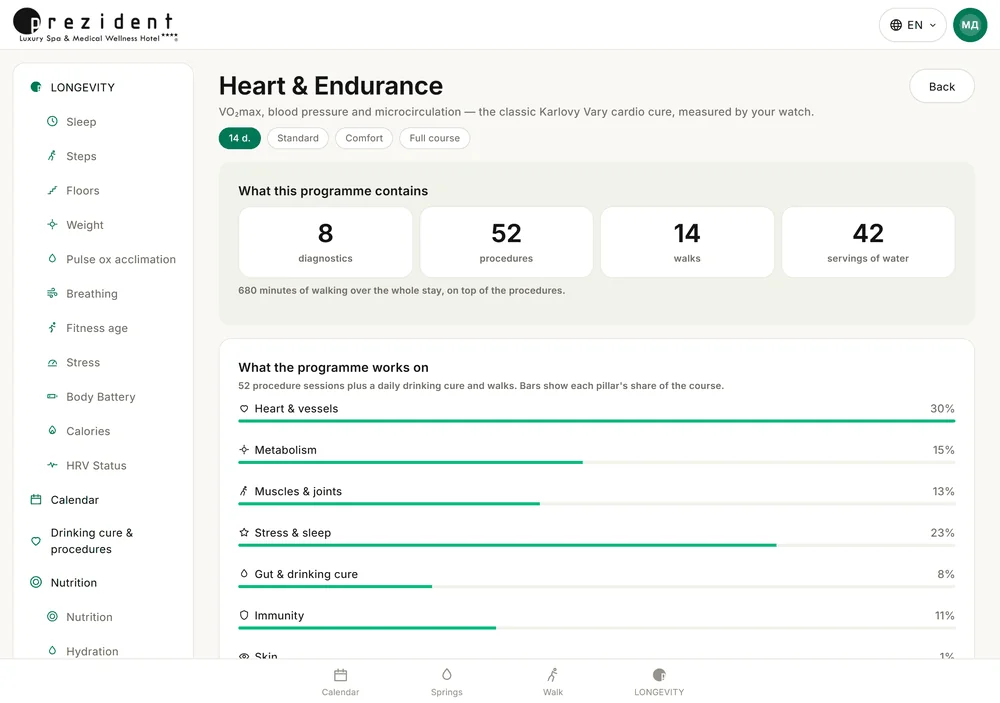
The three pillars the algorithm spreads treatments across are heart and vessels, recovery and immunity. In the demo guest's 14-day plan that came to 30 % of the sessions on heart and vessels, 23 % on stress and sleep, 15 % on metabolism, 13 % on muscles and joints, 11 % on immunity and 8 % on the gut and the drinking cure.
Contraindications are applied before the algorithm starts laying out days: the quiz asks ten flags, and a ticked flag removes a treatment from the pool rather than hiding it in the interface. Four of them matter here: an acute cardiac condition and uncontrolled hypertension close the sauna world and cryo-hydrotherapy, a pacemaker or metal in the joints closes BEMER, hyperthyroidism closes iodine-bromine baths, an acute illness closes dry CO₂ baths.
Everything the quiz cannot know — thrombophlebitis, a recent procedure, current medication — the doctor adds at the examination. From that moment the plan is rebuilt with the doctor's data; the thresholds and flags are set out in the numbers the doctor moves procedures by.
The six markers the course runs on
The markers were not picked for the shop window: each covers its own piece of physiology and arrives its own way. Four are read from the watch around the clock, two are computed from recorded walks. Every figure in the portal is explained in what the watch measures.
Marker
What it shows
Where it comes from
What follows from it
VO₂max, ml/kg/min
Aerobic reserve: how much oxygen the body manages to deliver and spend under load
Estimated from walking pace, climb and heart rate on a recorded walk; the error is about 5 ml/kg/min
Sets the pulse corridor and the length of the walking route for the stay; the portal prints the median for the age next to it
Resting heart rate, bpm
How economically the heart works at rest
Measured through the night; compared with the guest's own average for the stay, not with somebody else's norm
A rise of 5 bpm or more — a day without demanding treatments and without fast walking
HRV, ms
Heart rate variability through the night: the balance of the sympathetic and parasympathetic branches, the reserve for adaptation
Measured continuously at night; the baseline is the guest's own nights, 2 days at the least
A drop of 15 % or deeper — the sauna comes out and the walk is shortened by 30 %
Heart-rate zones
Which zone the walk actually happened in
Heart rate from the watch along the recorded route, split into zones
The course aims at the second zone; the weekly mark is 150 minutes in it
SpO₂, %
How saturated with oxygen the blood is at night
The watch's night pulse oximeter
Below 90 % is a safety warning; two nights in a row raise a "show this to the doctor" line
Intensity minutes, min/week
The weekly volume of useful aerobic load
Counted by the watch from heart rate and the length of the activity
Too few — the plan adds a walk; too many against a fallen HRV — the day is unloaded
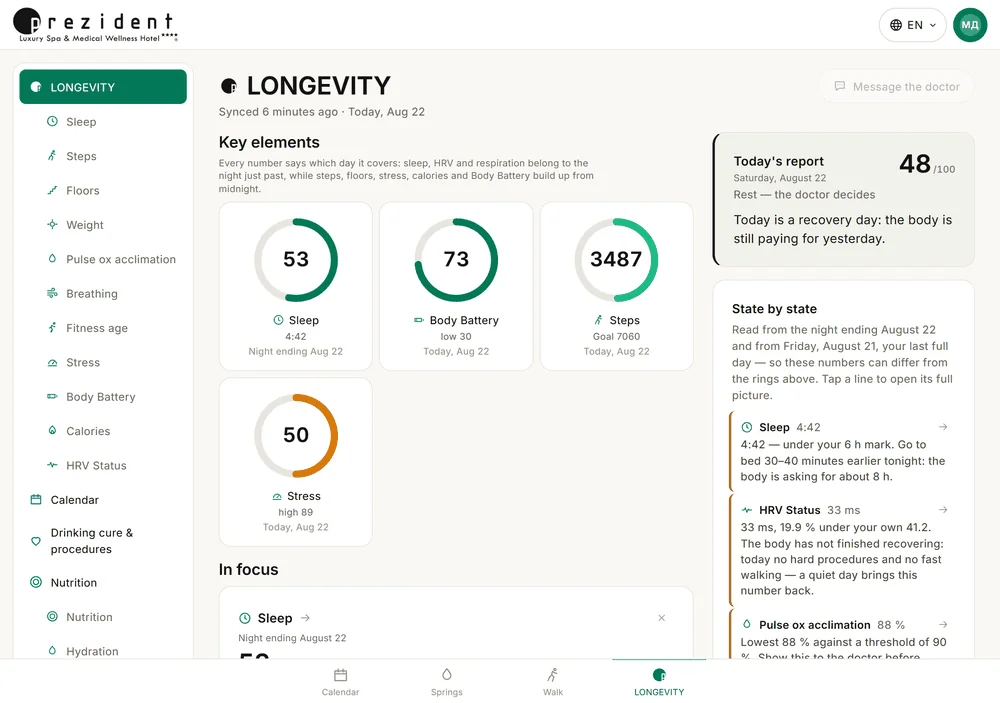
The demo guest's LONGEVITY screen in a browser window: the day's rings on the left, "State by state" on the right — HRV 33 ms, 19.9 % under the guest's own 41.2, and the conclusion in one line: today no hard treatments and no fast walking×
The guest's screen, read by the doctor
The doctor and the spa coordinator look at the portal from a desktop, which is why the screenshots here are browser windows and not the guest's phone: only that way do the six markers sit side by side. The guest sees the same figures on a phone, stacked into one column.
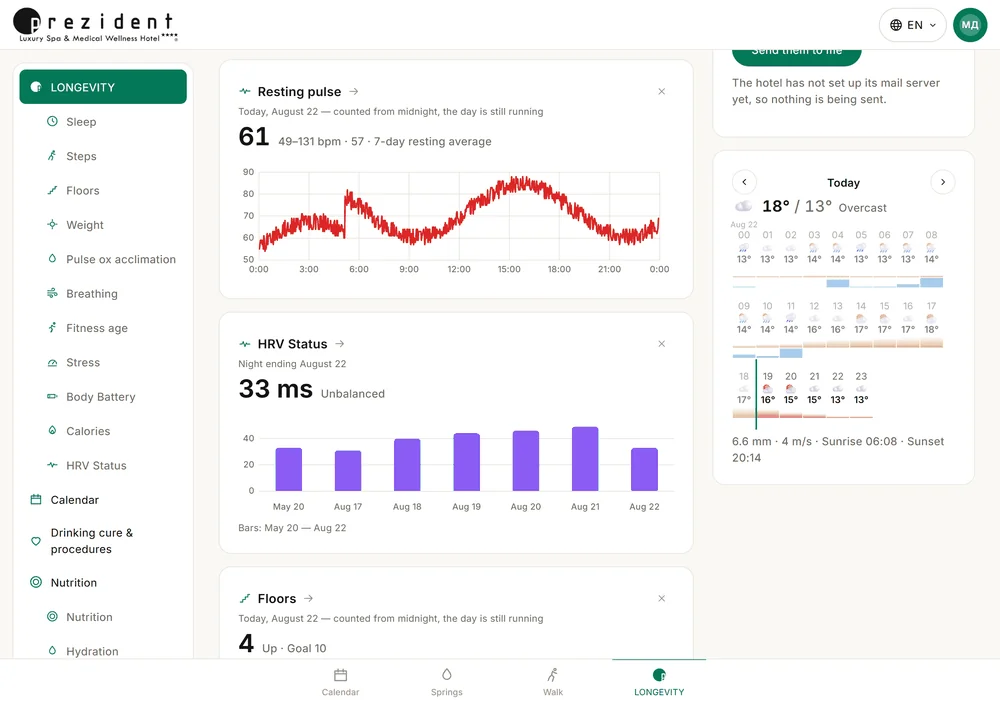
Resting pulse and HRV stand as neighbouring cards. The pulse carries the day's curve with its night minimum, the day's range and the seven-day average; HRV carries bars for the last nights and a word — balanced or not. The doctor needs both at once: one night proves nothing, while two weeks of a stay show the direction of the course.
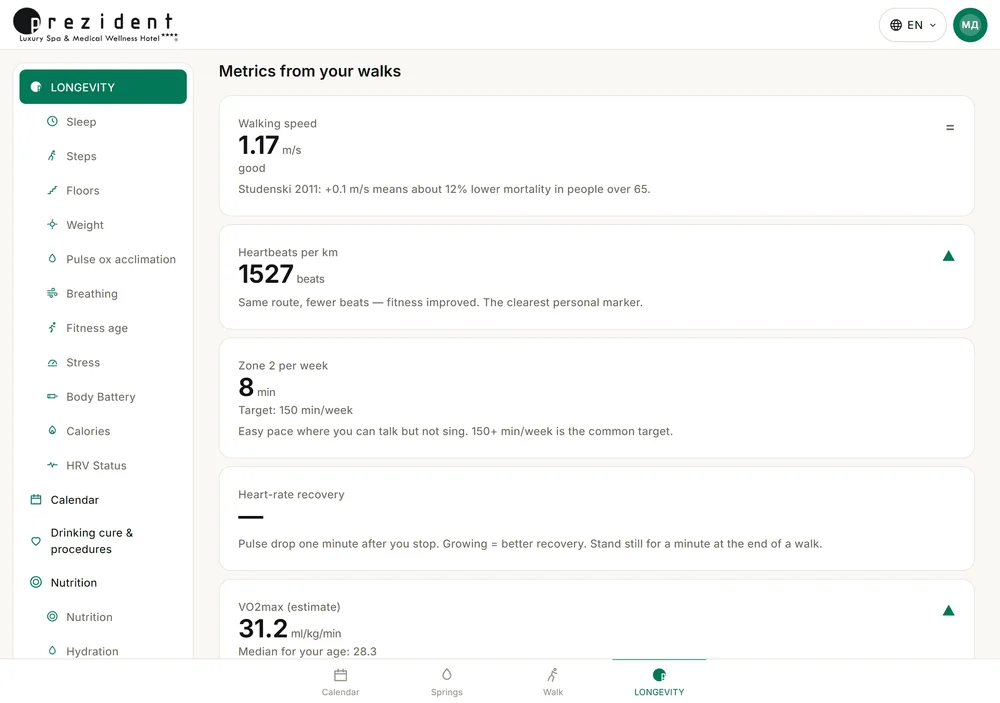
VO₂max, zone 2, walking speed and heartbeats per kilometre live on a separate screen, Walk metrics: these are the figures the platform computes from recorded walks itself. Each one carries its reference next to it — the median for the age, the weekly target, the threshold from the study — so that the number reads without a calculator.
Resting pulse and HRV side by side: 61 bpm against a day range of 49–131 and a seven-day average of 57, and below it 33 ms for the night with bars for the nights before×Walk metrics: walking speed 1.17 m/s, 1527 heartbeats per kilometre, 8 minutes in zone 2 against a target of 150 a week, and a VO₂max estimate of 31.2 ml/kg/min against a median of 28.3 for the age×
The medical frame of the stay
The frame is the set of items placed by protocol rather than by the treatment schedule: their day is fixed and they enter the plan before the algorithm starts filling in the core of the course. A fourteen-day stay has eight of them.
Day 1 — the examination (30 min, CZK 2,000), the drinking cure prescription (15 min, CZK 800) and an ECG (15 min, CZK 350). This programme gives every guest an ECG regardless of age: in the other programmes it appears only past 60.
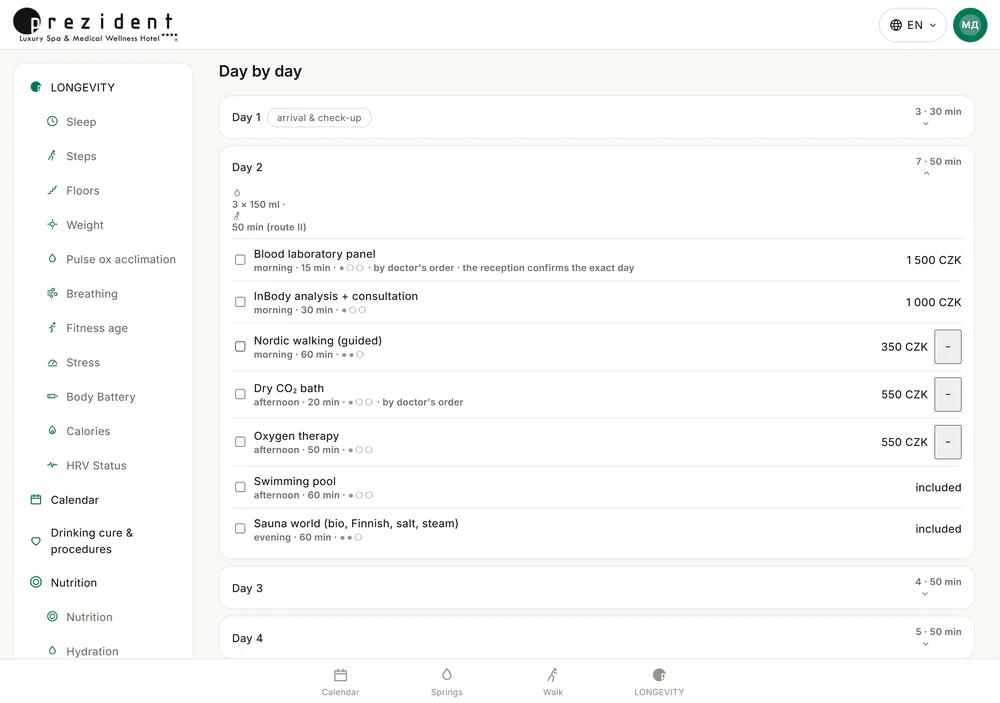
Day 2 — the blood laboratory panel (15 min, CZK 1,500) and the InBody analysis with a consultation (30 min, CZK 1,000). The laboratory is added from a 7-day stay, body composition from 10 days. The exact laboratory day is confirmed by the desk: the nurse keeps her own schedule.
Day 8 — the mid-course doctor consultation (20 min, CZK 1,100). Half the course is behind, and there is something to compare: a week of nights, walks and treatments.
Day 13 — the InBody measurement repeated, so that the closing consultation has two numbers rather than one.
Day 14 — the closing doctor consultation: what changed, and what to keep doing at home.
What can be added. For this goal the portal offers three modules: an extended blood panel — lipids, HbA1c, hsCRP, ApoB (CZK 4,500), a carotid and leg vessel ultrasound (CZK 1,900) and a specialist consultation, cardiology or gastroenterology (CZK 2,000). Spectral HRV analysis (SAHRV, 90 min, CZK 2,700) is prescribed by the doctor separately: the auto-planner never schedules items like it.
The demo guest's plan day by day, with day 2 open: the laboratory and InBody in the morning, Nordic walking, a dry CO₂ bath and oxygen in the afternoon, the pool and the sauna in the evening; every item carries its slot, its length and its intensity dots×
The core of the course: dose, length, limits
The dose of every treatment is written into the programme itself, and above it sits the weekly ceiling from the hotel's list. The algorithm will not exceed that ceiling even when the day is empty and the budget allows it.
The reserve beyond the core. Classical massage (20 min, CZK 650), a pearl bath (15 min, CZK 600), mineral water inhalation (10 min, CZK 250), apparatus lymphatic drainage (45 min, CZK 700), H₂ hydrogen therapy (30 min, CZK 550) and cryo-hydrotherapy (10 min, CZK 620). The algorithm draws on these when the core has hit its weekly ceiling.
How many paid items a day the budget allows:2 on standard, 3 on comfort, 4 on premium. The pool, the sauna world and the walk are outside that count: they are included in the stay.
Cryo-hydrotherapy is the only item of the reserve at the third intensity step. An acute cardiac condition, uncontrolled hypertension, a pacemaker, pregnancy and an acute illness remove it through the quiz, and on a strained day the night loop takes it out.
Treatment
Dose per week
Length
Price
Who does not get it
Dry CO₂ bath
5 sessions
20 min
CZK 550
acute illness; by doctor's order only
Oxygen therapy
3 sessions
50 min
CZK 550
—
BEMER vascular biostimulation
3 sessions (ceiling 4)
12 min
CZK 400
a pacemaker or metal in the joints; by doctor's order only
Iodine-bromine bath
2 sessions (ceiling 3)
20 min
CZK 650
hyperthyroidism, acute skin condition, pregnancy
Sauna world (bio, Finnish, salt, steam)
3 sessions (ceiling 4)
60 min
included for hotel guests
an acute cardiac condition, uncontrolled hypertension, pregnancy, acute skin condition
Nordic walking (guided)
3 sessions
60 min
CZK 350
—
Swimming pool
5 sessions
60 min
included for hotel guests
acute skin condition
How the treatments move the markers
A marker out of its corridor is not a diagnosis but a reason to prescribe a treatment that works on the system in question. The mechanisms below are described the way resort balneology describes them, and the studies in Sources show associations in cohorts, not guarantees for one person.
What the figures show
Threshold
What is prescribed
What the effect rests on
A low VO₂max, few intensity minutes
Under 150 min in zone 2 a week
Guided Nordic walking on the resort routes, the pool, oxygen therapy
A larger stroke volume and denser capillaries in the working muscle: volume without acidosis
A high resting pulse, a sharp rise on climbs
+5 bpm over the guest's own average
Dry CO₂ baths, iodine-bromine baths, the drinking cure
Carbon dioxide crossing the skin widens the pre-capillaries and lowers peripheral resistance; a warm iodine-bromine bath acts as a mild sedative
A fallen HRV, a night without recovery
−15 % against the guest's own baseline
BEMER biostimulation, pearl baths, classical massage
Restoring the rhythmic vasomotion of the capillaries and vagal regulation; the demanding items come out of the day
Low night saturation
SpO₂ under 90 %, repeated two nights running
Oxygen therapy, mineral water inhalation, H₂ therapy
Better alveolar-capillary diffusion; a repeat below the threshold is a reason for an examination, not for the next treatment
Zone 2: why the course walks slowly
The second heart-rate zone is the pace where you can talk but not sing. The programme keeps the walk there: it is the zone where the capillary bed grows and fat oxidation works while lactate does not pile up, so the afternoon treatment after the walk does not turn into an overload.
The weekly mark is 150 minutes in zone 2: that is the moderate aerobic activity the WHO recommends an adult per week, and the same figure stands as the target on the guest's screen.
The daily walk is set by the pace of the stay: gentle — 30 minutes and 6,000 steps, standard — 50 minutes and 8,000, active — 75 minutes and 10,000. The route is picked in the matching category: Trasa I, II or III (how the pulse corridor works).
Walking speed is a marker in its own right, not a by-product. The portal shows it in metres per second and prints what a gain means next to it: +0.1 m/s is associated with roughly 12 % lower mortality in people over 65.
Heartbeats per kilometre is the most honest personal marker of the course: the same route, fewer beats — the fitness has improved. It depends neither on the weather nor on the mood nor on which wrist the watch is worn.
What fourteen days add up to
The assembled course fits one screen: how much diagnostics, how many treatments, walks and servings of water it holds. Below is the demo guest's plan, the same one as in the screenshots above.
8 diagnostic items — the frame from the section above.
52 treatment sessions across the two weeks.
14 walks and 680 minutes of walking on top of the treatments.
CZK 31,670 (about EUR 1,267) — the treatment part of this plan at the hotel's 2026 price list. The room, the board and the city tax (CZK 50 per adult per night) are counted separately.
The demo guest's plan carries a second goal, stress and sleep, so it holds items beyond the core; another guest's pillar shares and total will differ.
What the programme contains on the portal's screen: 8 diagnostics, 52 treatments, 14 walks, 42 servings of water and the pillar shares — heart and vessels 30 %, stress and sleep 23 %, metabolism 15 %×
The night loop: what the portal changes itself
Every morning, never before 06:00, the night just passed is compared with the guest's own average and today's day is edited. The whole mechanism is described in how the platform prescribes procedures; what follows is what matters to a cardiac programme.
What counts as strain. A resting pulse 5 bpm above the guest's own average, HRV 15 % below their own baseline, a Body Battery under 40 points, a day's cardiac load 50 % above their own — and the same deviations repeated 3 days running.
What the portal does by itself. The included heat item — the sauna world — is dropped from the day without asking: it is free and it is ours, and the guest can put it back with a button. The walk is shortened by 30 %, but never below 20 minutes.
What the portal never does silently. Paid treatments are not swapped on strain by default: the automatic swap (no more than two a day) is switched on in the super-admin panel; otherwise the morning sheet proposes the edit and the doctor decides.
Safety is counted apart.SpO₂ under 90 % and its repeat on two nights running do not edit the plan — they raise a "show this to the doctor" line on the morning sheet.
The day's readiness is built from the same figures with weights: Body Battery 30, HRV 25, sleep 25, resting pulse 10, load 10. The green zone starts at 75 points, the amber one at 50.
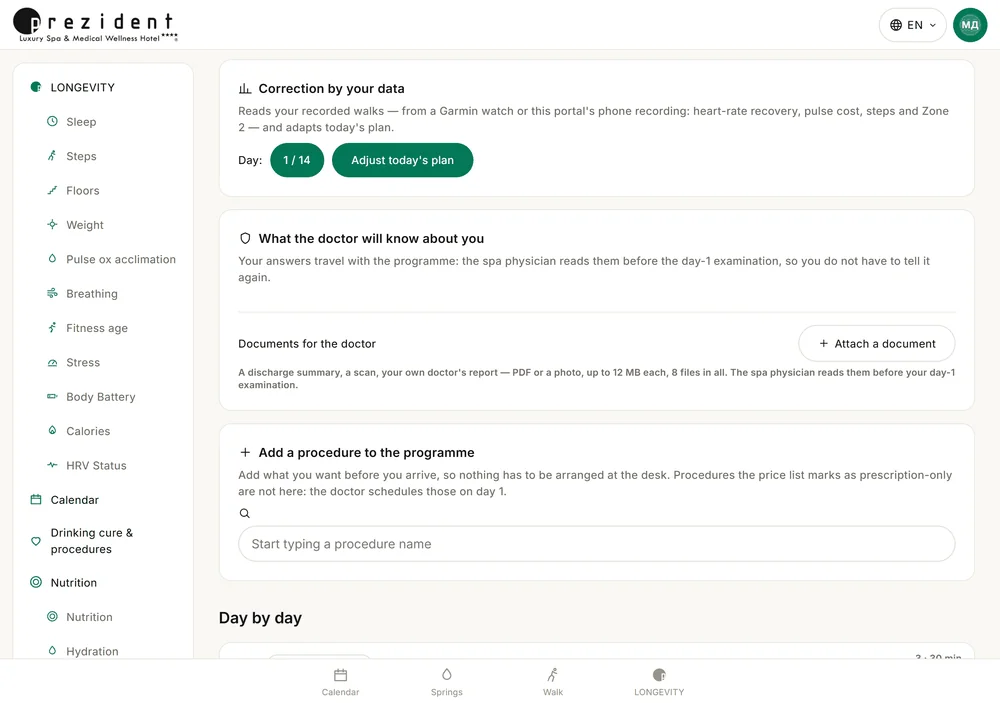
The "Correction by your data" block inside the guest's plan: the portal reads the recorded walks — heart-rate recovery, pulse cost, steps and zone 2 — and adapts today's day×
What the programme does not do
It does not measure blood pressure. The Garmin Forerunner 165 Music cannot; the hotel staff measure it with an ordinary cuff, and it reaches the plan from the doctor's note, not from the wrist.
It does not diagnose and does not replace a cardiologist. The portal supports lifestyle and the course of treatment, while the decision about a treatment belongs to the doctor (the legal framing).
It neither prescribes nor withdraws medication. The guest discusses their medication with the doctor at the examination; the portal does not keep it.
It does not record an ECG from the watch. The ECG is taken in the surgery on arrival day; the watch gives rhythm and variability, not twelve leads.
It does not promise a VO₂max gain in two weeks. The estimate carries an error of about 5 ml/kg/min, so during a stay the trend and the heartbeats per kilometre on the same route are read, not the difference between the first and the last measurement.
How to start the programme
The configurator quiz is open without signing in: fifteen questions, about two minutes, and out comes a day-by-day plan with its price and with the contraindications already excluded. On arrival the guest is handed the watch and a QR code at the desk, and the same plan opens in the phone's browser (how signing in works).
Choose the programme in the portalOpens the demo portal: the programme showcase and the configurator quiz, fifteen questions, about two minutes, no registration.
Questions and answers
How long does the Heart & Endurance programme last? The standard stay is 14 days, the minimum is 5. A plan for a shorter stay is built too, but it says plainly that the course has been cut short.
Which figures does the programme follow? Six: VO₂max, resting heart rate, heart rate variability, heart-rate zones, blood oxygen saturation and intensity minutes. Four arrive from the watch around the clock; VO₂max and zone 2 are computed from recorded walks.
Does the guest need their own watch? No. The hotel's kit — a Garmin Forerunner 165 Music — is handed over at the desk; the guest scans a QR code and opens the plan in the phone's browser, installing nothing.
What happens if HRV fell overnight? The portal takes the sauna out of today and shortens the walk by 30 %, and offers the doctor a swap for a paid treatment on the morning sheet. The course is not interrupted by that: an unloaded day is part of the course.
Is the programme possible with hypertension? The plan is built, but the "uncontrolled hypertension" flag in the quiz removes the sauna world and cryo-hydrotherapy from it, and heat treatments stay with the doctor at the day-1 examination.