How a guest reaches their account — by a link from a letter, by e-mail and password, through Google, or from the desk's QR code. And why a session lasts two years.
The portal does not ask who you are twice. There are four doors and all of them open the same account — the one holding your nights, your prescriptions and your walks.
A link from a letter. The commonest door. Everything the portal sends you — the questionnaire, your results, the daily report, the walk card — arrives as a link that already carries the pass. Nothing to type.
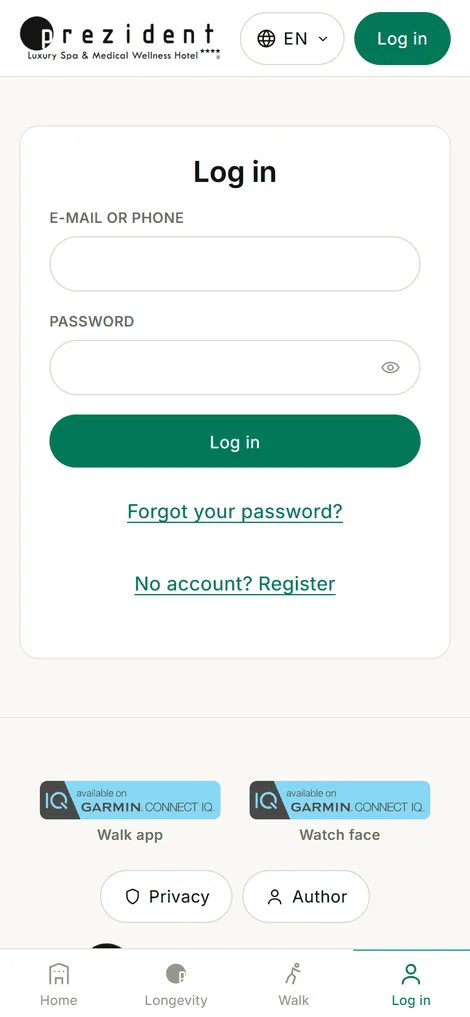
E-mail and password. The ordinary form at `app.karlovyvary.info/#/login`.
Through Google. One button. Google has no separate sign-up here: the first sign-in creates the account.
The desk's QR code. When the kit is handed over at the desk, reception opens a «Sign-in details» window with the address, the password and a square — the phone is pointed at it and the account opens (what that looks like from the desk).
A forgotten password
«Forgot your password» sends a link that lives 60 minutes and works once; a new request puts out the previous link.
The answer is the same for an address that exists and one that does not — «the letter has been sent». That is not evasion: a different answer would turn the form into a way of checking who is being treated in this house.
A session lasts two years
The owner's decision: «signing in should last more than a year». A guest arrives in March and comes back in September — there is no point making them remember a password in between, all the more since their previous stay is waiting in that account.
Not forever, and deliberately so: a pass with no expiry on a lost phone would open somebody's health record for good. Kit tablets are a separate matter — reception wipes their session at every handover (why).
Signing up without the desk
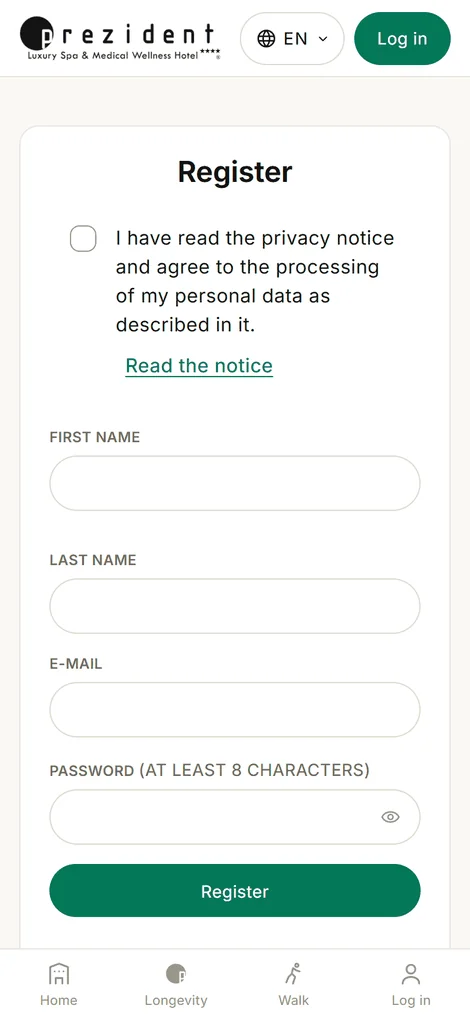
At `#/register` a person signs themselves up — with their own watch, their own ring, or no device at all. At that minute the portal knows one e-mail address about them, so the first screen is not LONGEVITY but a short questionnaire: nine lines, of which name, sex, date of birth, height with weight and the health-data consent are required. The rest sharpens the arithmetic but does not hold the «Add» button.
Sex and date of birth are not asked out of politeness: the pulse ladder, the fitness age and the thresholds of the morning sheet all stand on them (which ones exactly).
Which wrist the device is worn on is not asked here — this door is for someone without our watch, and the desk settles the wrist in the minute the kit is handed over.
Signing up: one door for both e-mail and Google×Signing in with e-mail and password×
Who you are to the portal
There are four roles on the guest's side of the desk, and all four see the same account with the same rights. The difference is read by the panel — so that in a list of two hundred sign-ins it is visible which of them is the house.
Role
Who that is
Hotel guest
checked in, given a kit, on the programme
Guest's phone
checked in, but carrying their own phone instead of our kit: the programme works in full, only without the numbers from the wrist
Own device
signed up at `#/register`; never came to the desk
User
the old public sign-up. No new ones appear; the old ones live on under their name
What reception does
A guest does not need an account beforehand. The desk asks for a first name, a last name and an e-mail; everything else arrives by post. With no e-mail at all the portal makes a service address and the guest signs in from the code on the screen.
The desk is also what turns «own device» into «hotel guest» when the kit is issued. A password the person chose themselves is not overwritten in the process — checking in has no right to quietly shut their door.