Longevity programmes: configurator, price and corrections
An eleven-question quiz assembles a day-by-day programme out of the hotel's 139 treatments, prices it, and then keeps correcting the plan by what the watch has seen.
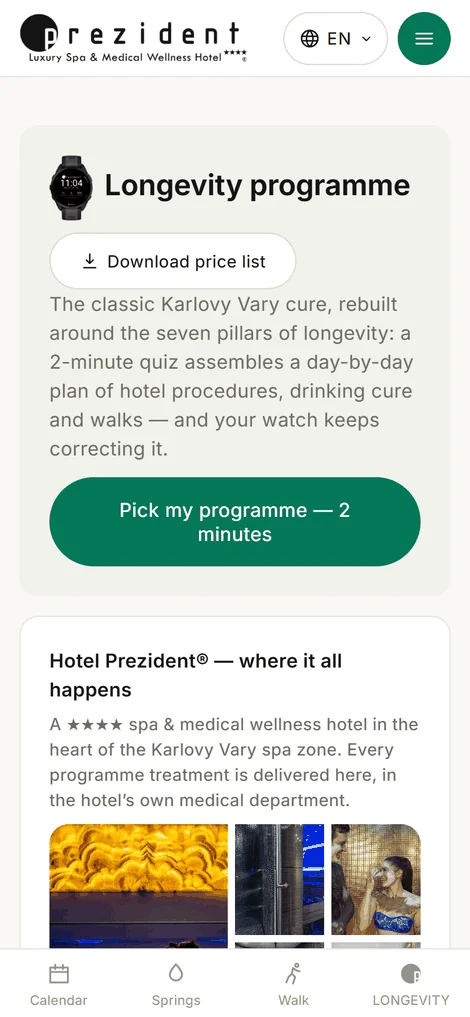
The classic Karlovy Vary cure, rebuilt around the seven pillars of longevity. The guest answers eleven questions (two minutes), the portal assembles a day-by-day plan out of the hotel's real services, prices it with a room and board — and from then on corrects the plan by what the wrist reports.
The configurator is open without signing in: it is a shop window, not a private section. The assembled plan is saved to an account if there is one.
The programmes page: the price list, the quiz and the hotel block×
The catalogue: 139 treatments
Every treatment carries the seven pillars (scored nought to three), its contraindications and its intensity. That is what the planner lays the days out by — not by the prettiness of a timetable, but by what goes with what and what follows what.
Fifty-two entries are marked as not to be placed automatically: acupuncture, applied kinesiology, the Thai techniques, KOBIDO, the cosmetic rituals — and paperwork such as a prescription or an insurance certificate. Some have unverified dosing, others are not treatments at all; the planner leaves both alone. They can still be booked, by hand, through «Add procedures».
The prices are real
The price list comes from the hotel's official 2026 tariff. Most entries have two prices: «with treatment» (which is what the calculator uses — a programme is a treatment package) and «without treatment» for a single visit.
Four entries are marked as included and priced at nought: the drinking cure, the pool, the gym and the sauna world — free to residents. Three entries outside the printed tariff — the extended blood panel, the abdominal ultrasound and the vascular one — carry an estimate, and the card says so.
The tariff itself sits beside it as a «Download price list» button in the page's header — a PDF you can print and show.
Correction by your own data
The plan does not stay as it was assembled on day one. The portal reads your walks and corrects by them: a high pulse cost or slow recovery, and a heavy treatment is swapped for a restorative one; too few steps, and a walk is added for tomorrow.
The block is called «Correction by your own data», not «by the watch»: the source can be our kit, another maker's watch, your smartphone (the portal records GPS walks itself) — or nothing yet.
The threshold at which a treatment counts as heavy is the same one the doctor uses on the morning sheet. The two halves of the system must not advise different things (the thresholds).
Functional tests
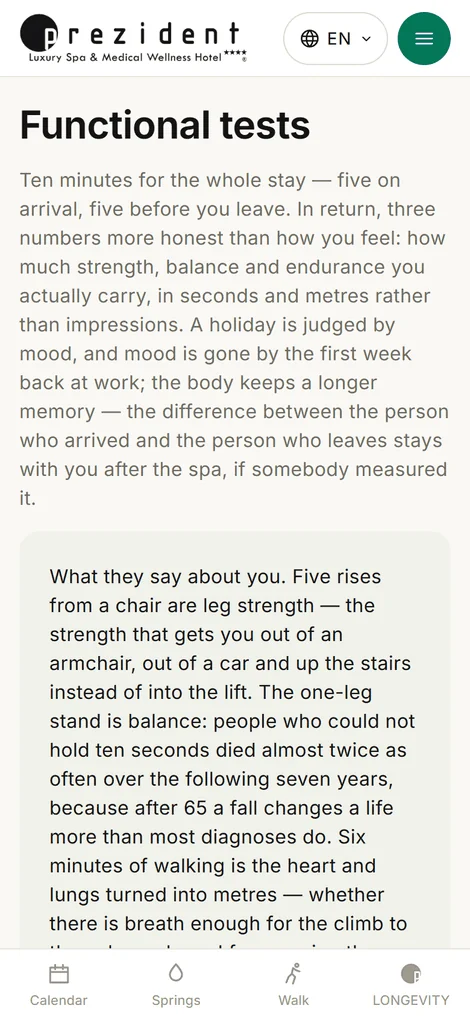
Functional tests are a section of the account in their own right — the three that the watch records: chair stands, the balance test and the six-minute walk. Above them is written what they are for and what happens to the number, below them a step-by-step instruction with drawn watch screens.
Grip strength is not in the interface: there is no dynamometer in the house, and a line reading «not measured» every morning makes a poor instruction. It comes back with the instrument.
«Functional tests»: why, then what happens next, then the steps×
How this works for a person
You open the programmes before you even arrive, answer eleven questions and see: here is a fortnight's plan day by day, here is what it costs with the room and board you chose, and here is a «Get a personal discount» button that opens a conversation with the hotel already carrying the whole order.
When you arrive you are given the watch — and the plan starts adjusting to what it sees.
What reception does
The programmes are a shop window and a subject of conversation at the desk: guests often arrive with an assembled plan on their phone. It is the doctor who approves and books the treatments; a guest's order reaches them as a request (how).