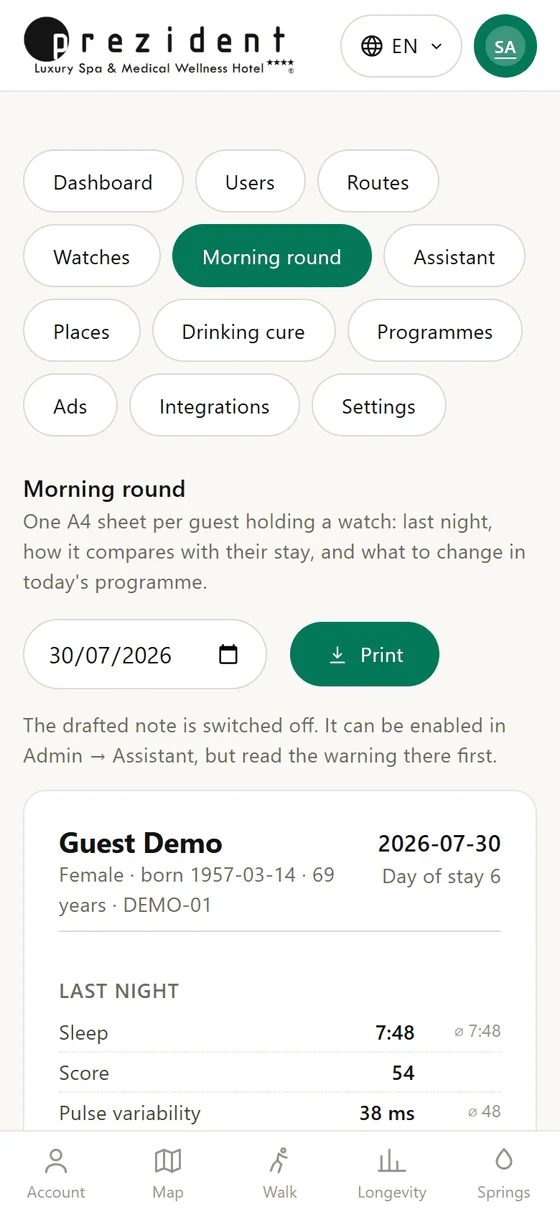
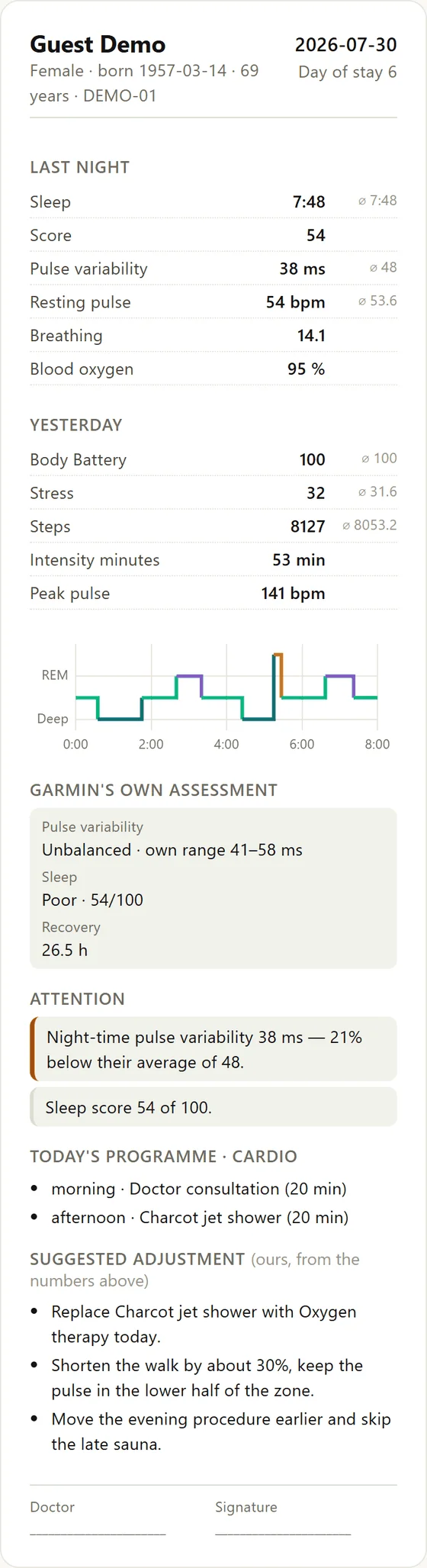
The morning sheet compares the guest's night with their own average and proposes a correction. Here are all the thresholds, all the flags and what follows from each.
The guest sleeps wearing the watch. In the morning the portal takes their own last night and compares it not with a table of age norms but with their own average for this stay. Anything out of line raises a flag and proposes a correction: swap a heavy procedure, shorten the walk, show the guest to the doctor.
The doctor decides. The portal changes no procedure by itself — it prepares a sheet that shows why this is proposed, and the doctor agrees or does not.
The guest sees only the outcome — their programme for the day. Thresholds and arithmetic stay in the panel.
The morning round: one strip per guest×One guest's sheet: flags on the left, the proposed correction on the right×
Two families of rule
Family
The question
Measured against
One night
«Should this person train today?»
tonight against their own average for the stay
Several days
«Is the programme too heavy at all?» One bad night after a late dinner is noise; the same for three nights is not.
a run of days
One-night thresholds
Defaults; each is movable by the doctor in Panel → Rules, but only inside an allowed range — an oxygen alarm «adjusted» to 80% is refused.
Parameter
Threshold
Flag
Proposal
Resting pulse above own average
+5 bpm
«Resting pulse up»
swap the heavy procedure, shorten the walk
Heart-rate variability below own
−15%
«HRV down»
the same
Sleep shorter than
6 h
«Short sleep»
move the evening procedure earlier, skip a late sauna
Sleep score below
60 of 100
«Poor sleep»
the same
Average stress above
50
«High stress»
add a breathing session, check the drinking cure's timing
Body Battery only recovered to
40
«Did not recover»
swap the heavy procedure, shorten the walk
Blood oxygen dipped below
90%
«Oxygen dip»
show the guest to the doctor before today's procedures
Cardiac load above own average
+50%
«Load higher than usual»
swap the heavy procedure, shorten the walk
Multi-day thresholds
Parameter
Threshold
What follows
The deviation holds for
3 days
review the rest of the stay, not only today
The trend window
5 days
—
Average sleep over the window below
6.5 h
accumulated debt: morning procedures later, evening ones earlier, and a word with the guest
Daily Body Battery peak fell by
10 points
lower the load of the stay as a whole — drop one heavy procedure from the remaining week
Oxygen dipped below the threshold on
2 nights
show the guest to the doctor: no longer a one-off
Readiness for today
The same numbers make one figure, the way Oura calls it Readiness and WHOOP calls it Recovery. Only the balance is configurable.
Component
Default weight
Body Battery
30
Heart-rate variability
25
Sleep
25
Resting pulse
10
Load
10
Green from 75 points: «programme unchanged». Amber from 50: shorten the walk by about 30% and keep the pulse in the lower half of the corridor. Below that, a heavy procedure is proposed for swapping.
The point at which a component loses its weight is the same threshold that raises the flag above, so the panel never holds two different truths about one resting pulse.
Panel → Rules: every threshold with its range and its consequence beside it×
The functional tests on the same sheet
Tests taken on the watch land on the same sheet and raise their own flags: grip strength, five stands, one-leg balance, the six-minute walk. Below threshold, the sheet proposes not treatment but another procedure. Not taken at all — it says that too. How to take them is step by step here.