Sleep score — 0 to 100, from the length and make-up of the night: how much deep, light and REM sleep there was and how often you woke. Above 80 is a good night.
Sleep stages. Deep sleep restores the body, REM the head. Their share matters more than the total: seven broken hours are worse than six calm ones.
HRV, heart-rate variability — the spread of intervals between beats overnight, in milliseconds. The earliest sign that the day's load was too much: it drops before you feel tired. Everyone's normal is their own — compare it with yesterday's you, not with your neighbour.
Resting pulse — the lowest pulse of the night. It rises with overload, short sleep, alcohol and an oncoming cold; it falls as fitness grows.
Breathing — breaths per minute while asleep, usually 12–20. Even breathing is the mark of a calm night.
Blood oxygen (SpO₂) — overnight saturation, in per cent. In Karlovy Vary, at four hundred metres, the first nights may read slightly lower than at home — that is acclimatisation.
The day
Body Battery — an energy reserve from 0 to 100. It fills during sleep and rest and drains with effort and stress. Watch the swing rather than the number: how much the night charged and how much the day spent.
Stress — 0 to 100, from the same variability, only by day. High values are not necessarily nerves: a climb counts as stress too.
Steps and floors — how far you walked and how much you climbed. The step goal is set by the doctor or by the watch itself; in Karlovy Vary it is filled by walking, not by a gym.
Calories — the day's spend: rest plus movement. It depends on height, weight, sex and age — which is why the card is filled in at the desk.
Intensity minutes — time spent at a pace that actually loads the heart. The World Health Organization's mark is 150 minutes a week, and brisk walking collects them nicely.
The summary numbers
Fitness age — your endurance spoken in years: the age at which your current aerobic capacity would be the middle. Unlike the passport kind, it moves both ways.
Report for today — a short reading of every state in words: what changed since yesterday and what to do about it. It arrives by letter and sits on the portal's first page.
The walks, drawn on the curves
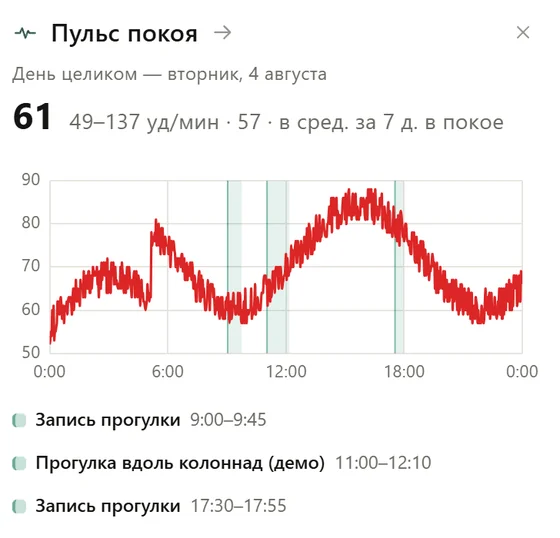
On the day curves of the first page — pulse, stress, energy, oxygen, breathing — the time of every walk is shaded, with the route's name above it. The curve alone does not say this: a pulse rise at one in the afternoon looks the same whether it was the Gogol trail or the stairs to the room.
Below the chart the same walks are listed in words — the route's name and the hours — because an hour-long walk on a 24-hour axis is fifteen pixels of a phone, and a long name rarely fits above it. Pressing the band or the line opens that walk's own reading.
One walk shows as one band even when it was recorded twice, by the phone and by the watch; the record that carries a route is the one that names it. A walk with no route assigned is simply called a «walk recording».
A day of pulse: three bands, three outings, and their names below the chart×
What the numbers do not know
A watch is not a medical instrument. Medicines that slow the pulse, a fever, a glass of wine the night before, or simply taking the watch off will bend any of these figures.
So the portal shows a direction, not a verdict: one night says little, a week says a lot. Anything worrying is for the hotel's doctor — the same numbers are on the desk at the morning round.