A balneology course for joints and spine: 14 days by default, 5 minimum. Peat packs, sulphur baths, underwater massage, aqua gym; six watch measures show how it goes.
What this is. Joints & Mobility is the platform's balneology programme against chronic pain in the joints and the spine. The course rests on peloid therapy (treatment with natural peat mud), sulphur baths, unloading the spine in water and gentle daily movement.
How long it runs. The default stay is 14 days, the minimum 5. A shorter one is still assembled, but the plan marks the course as cut short.
The core. Peat mud packs, sulphur baths, underwater and therapeutic massage, the hydrojet bed, magnetotherapy, aqua gymnastics and the pool — 35 sessions over a 14-day stay on the standard budget.
The backbone. A daily walk over real terrain — 30, 50 or 75 minutes by the chosen pace — mineral water 3 times 150 ml, and the pool.
What shows how the course goes. Six measures, all six from the watch: steps, distance, pace, floors, intensity minutes and Body Battery.
What counts as a result. Three functional tests on arrival and before departure: five chair stands, the one-leg stand, the six-minute walk. The course is measured in seconds and metres, not in how the guest feels.
Who decides. The algorithm drafts, the doctor signs it at the day-one examination (how the plan is built). Mud, magnetotherapy, electrotherapy, ultrasound and traction never enter a plan without the doctor's order.
Who this text is for. The resort's doctor and spa coordinator, as a working guide; the guest choosing a course, as a description of the programme. Updated 22.08.2026.
What this programme is
The programme is built around two old spa instruments: heat and water. Peloid therapy is treatment with natural peat mud — a pack holds its temperature far longer than water and warms the tissue around the joint without loading the heart the way a hot full bath does. Balneology is treatment with mineral water; here it is the sulphur bath, where sulphur passes through the skin.
The aim is a plain one: release the muscle spasm around a painful joint, take down the swelling around it, give back a pain-free range of movement and grow the distance walked in a day. Restoring cartilage nutrition is a matter of months, and a fortnight begins that work rather than finishing it — which is why the programme reports metres walked and seconds on a test instead of promises about cartilage.
The programme supports a way of living and does not replace treatment: the platform prepares a proposal, the resort's doctor prescribes. The items closed to self-booking — mud, magnetotherapy, electrotherapy, ultrasound, traction — do not enter the plan without their signature.
This is how the course looks assembled in the portal: a demonstration guest, a 14-day stay, standard pace and standard budget.
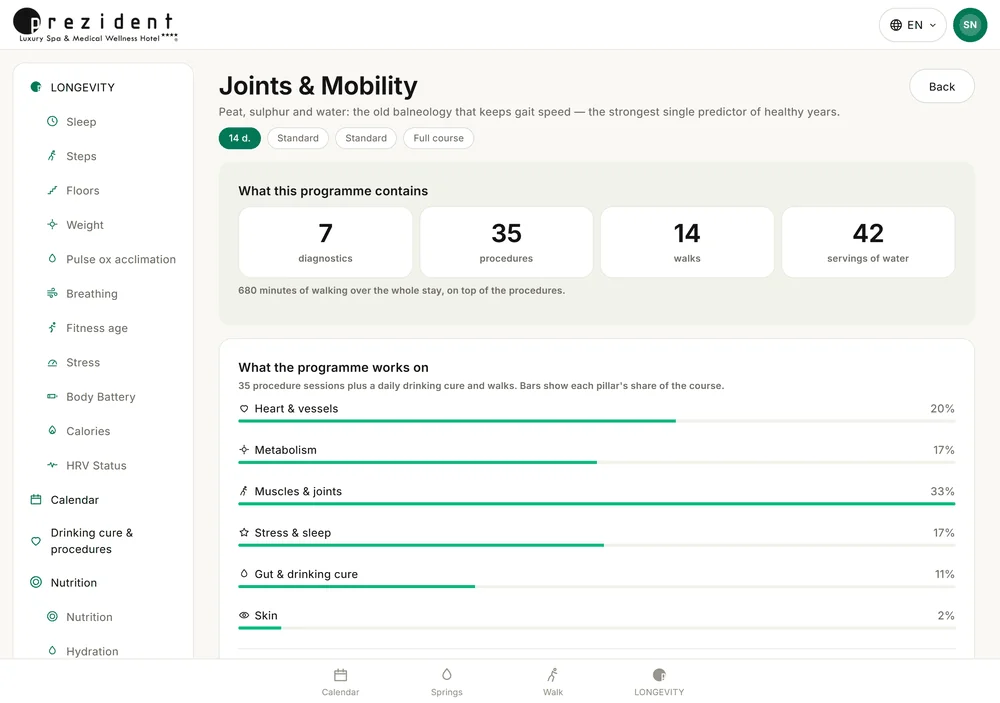
The Joints & Mobility programme in the portal: 14 days, 7 diagnostic items, 35 procedure sessions, 14 walks and 42 servings of mineral water; 680 minutes of walking over the stay on top of the procedures. The bars below are each pillar's share, with muscles and joints at 33 %.×
The six measures of the programme
Every programme keeps its own list of measures. This one has six, and all six come from the watch: the course is about movement, not about body composition.
They fall into two blocks. Biomechanics and locomotion — steps, distance, pace, floors: how far the guest walked and how. Tolerance of load — intensity minutes and Body Battery: what it cost them.
The hotel's kit is the Garmin Forerunner 165 Music; a guest's own watch works too, and in the screenshots below the demonstration guest wears a Suunto Race (your own device).
Measure
Where it comes from
What it shows
Reference and threshold
Steps
the watch, the daily counter
the day's axial load on the leg joints and the spine
the goal follows the pace: 6,000, 8,000 or 10,000 steps a day; the course grows the pain-free volume rather than hitting the goal at any price
Distance
the watch, from stride length and the recorded walk
the distance the guest covers without pain
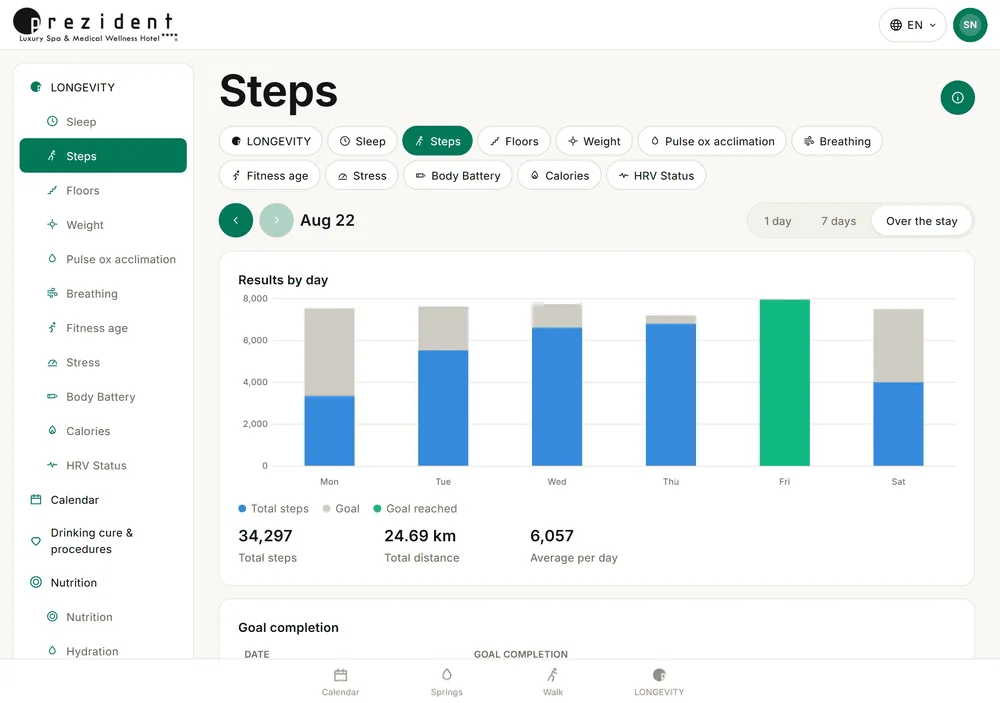
read as a line across the stay: the demonstration guest has walked 24.69 km at 6,057 steps a day on average
Pace
the watch, from the recorded walk
freedom and smoothness of gait: pain slows the pace before anything else
a rising pace at the same heart rate adds 10 minutes to tomorrow's walk; gait speed is associated with survival (Studenski, 2011)
Floors
the watch's barometric altimeter
climbs on the spa trails: the work of the quadriceps and glutes without compressing the joint surface
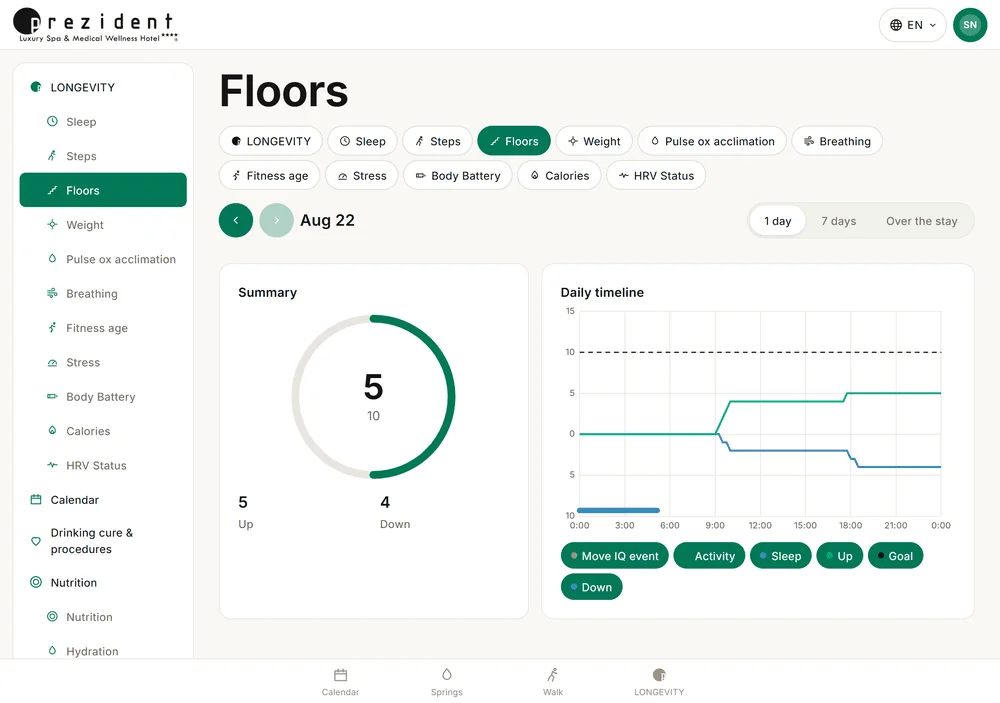
the daily goal is 10 floors; the guest in the screenshot has 5 up and 4 down
Intensity Minutes
the watch, from heart rate
time spent in the moderate zone: Nordic walking, aqua gymnastics, the pool
the WHO norm is 150–300 minutes a week; less than 100 minutes in zone 2 over a week is flagged separately
Body Battery
the watch, from heart-rate variability and activity
the energy reserve: what the body pays for mud and baths
the morning sheet flags below 40 of 100; that is the default, and the doctor moves it within 10–70
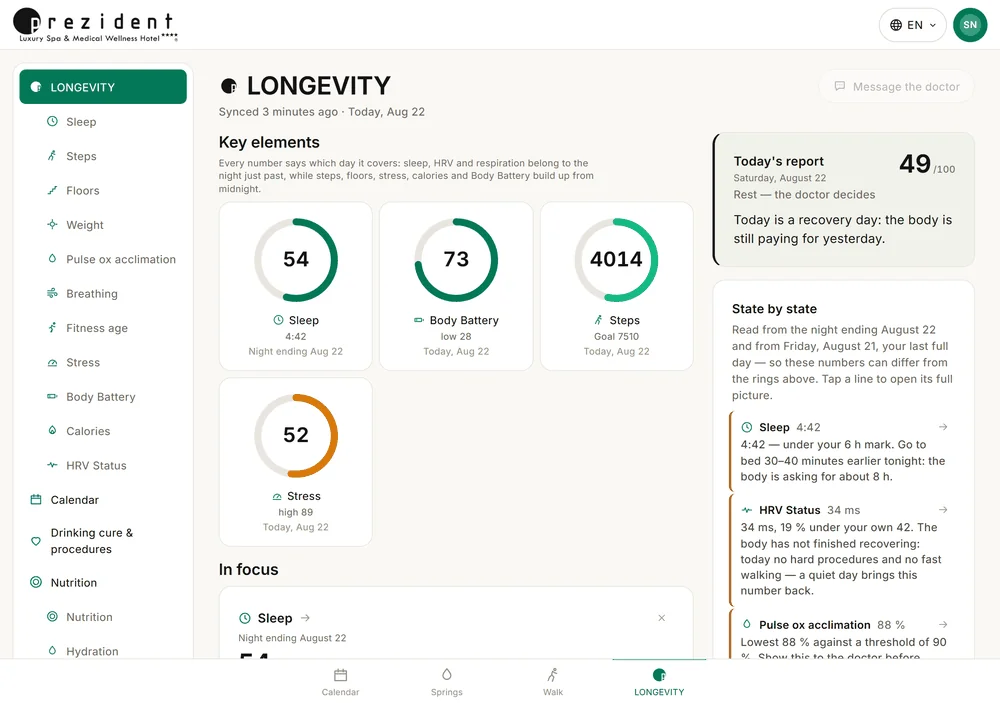
The LONGEVITY screen as the guest sees it in a browser window: the rings for sleep, Body Battery, steps and stress, and on the right today's report (49 of 100) with the night read out line by line.×Steps over the whole stay: 34,297 steps, 24.69 km and 6,057 steps a day on average. The green bar is the day the goal was reached.×
The backbone: walking, terrain, the pool
Three things are in the programme every single day, and none of them takes a paid slot.
The walk. On the standard pace it is 50 minutes on a category II trail, 30 on the gentle pace and 75 on the active one. On arrival day it is cut to 60 % — 30 minutes instead of fifty: the guest has travelled, not trained. Rhythmic walking is the main pump that moves synovial fluid, which is why the walk stands in the plan even on a rest day.
The terrain. Karlovy Vary trails go uphill, and a climb is not the same for a joint as a flat kilometre: it loads the muscle and unloads the joint surface when the pace is right. The watch's barometric altimeter counts the climb as floors and makes that work visible.
The pool. Ten sessions over 14 days, included in the stay and taking no slot. Immersion to the chest takes about 70 % of body weight off the joints, to the neck up to 90 %: where a joint hurts on the third minute on land, in water it holds half an hour.
The drinking cure runs alongside: 3 servings of 150 ml, with the spring, the temperature and the time before meals set by the doctor.
Floors for the day: 5 climbs out of a daily goal of 10 and 4 descents, with the timeline of when they happened. The barometer counts a climb even where the map draws a flat line.×
The core procedures and the extras
The core is what the algorithm lays down first. The "per week" column is the programme's norm; how many sessions land in a particular stay is arithmetic: the norm times the length of the stay, trimmed by the procedure's weekly ceiling and by the day that must pass between two of its sessions.
Procedure
Per week
Length and price
What it does
Peat mud pack
4, ceiling 4 in any 7 days
20 min · 600 CZK · by doctor's order
local heat and the anti-inflammatory action of peat: better nutrition for the ligaments, swelling around the joint drains
Sulphur bath
2, ceiling 3
20 min · 650 CZK
sulphur passes through the skin; degenerative joint disease is the classic indication for sulphur waters
Underwater massage
3, ceiling 3
20 min · 800 CZK
a pressurised jet inside the bath: deep muscle release while the spine carries no weight
Therapeutic back and joint massage
3, ceiling 3
60 min · 1,800 CZK
work on trigger points and fascial restrictions around the joint
Hydrojet dry massage bed
2, ceiling 3
20 min · 550 CZK
contactless hydromassage: the guest never touches the water and the joint carries nothing
Magnetotherapy
3, ceiling 4
15 min · 450 CZK · by doctor's order
a low-frequency field: anti-oedema and analgesic, with no heat involved
Aqua gymnastics
3, ceiling 3
30 min · 300 CZK
building the muscle corset in warm water with no impact load
Swimming pool
5, ceiling 7
60 min · included in the stay
free swimming and traction for the spine
The extras. Breuss spinal massage (30 min · 800 CZK), Thai massage (60 min · 1,590 CZK), electrotherapy (10 min · 450 CZK), therapeutic ultrasound (5 min · 400 CZK), laser (20 min · 500 CZK), peat mud bath (20 min · 650 CZK), biolamp phototherapy (10–20 min · 400 CZK), paraffin wraps for the hands (20 min · 550 CZK) and the feet (20 min · 380 CZK), spinal traction (2–5 min · 450 CZK).
What it costs. The demonstration guest's 14-day stay on the standard budget comes to 26,900 CZK without room and board: 35 procedure sessions and 7 diagnostic items. Inside that — 5 mud packs, 3 underwater massages, 2 therapeutic massages, 2 magnetotherapy sessions, 2 aqua gym classes, a sulphur bath, a hydrojet session, and 10 visits to the pool on top.
The budget decides how much paid work fits a day. Standard is 2 slots, comfort 3, premium 4. The pool, the gym and the walk take no slot at all.
Secondary goals blend in another core. The demonstration guest's second goal is stress, so floating, an aroma massage and an Indian head massage joined the plan: up to three items from the Deep Recovery programme, no more than two sessions of each a week.
A sliding seven-day window. The ceiling counts over any seven days in a row, not over a calendar week. Between two sessions of the same procedure at least a day must pass — two for the mud bath, the Breuss massage and traction.
How the course moves the measures
The table reads left to right: what the guest's screen shows, what stands in the plan because of it, and why the measure comes back.
What the screen shows
How it looks
What is prescribed
Why the measure comes back
Pace and steps have dropped
morning stiffness, a limp, a short walking distance
releasing the reflex spasm around the joint and warming the tissue give back the pain-free range of movement: the stride lengthens and the pace steadies at the same heart rate
Floors and intensity minutes are low
pain on climbs and descents, no confidence in the ligaments
aqua gymnastics, the hydrojet bed, a walk on a trail with a gradient
the stabilising muscles and the quadriceps strengthen in water, where there is no impact load; on land that shows up as a climb that does not hurt
Distance is not growing
tiring quickly on foot, a heavy back by evening
underwater massage, paraffin wraps, the pool
hydrostatic unloading and deep warming restore the elasticity of tendons and fascia, swimming lengthens the spine — the daily distance grows without adding pain
Body Battery is low, the night was hard
the balneological reaction: fatigue on the third or fourth day of the course
magnetotherapy, laser, biolamp instead of heat procedures
non-thermal methods work locally and barely spend the general reserve of adaptation: the course carries on while the body rests
What counts as a result: three tests
A spa result is easy to describe and hard to show. So mobility here is measured by three tests, taken on arrival and before departure. Each takes minutes, and each threshold comes from published work rather than from the house.
The test runs on the watch itself, the result reaches the portal within a minute and is compared at once against the threshold for the guest's sex and age.
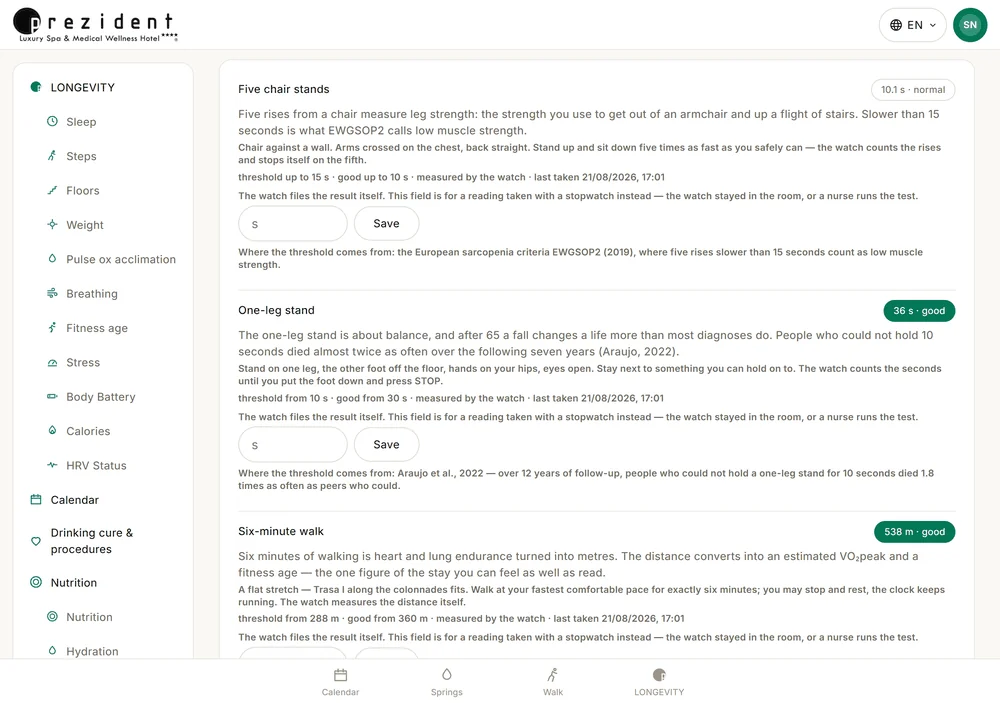
Five chair stands — leg strength. The threshold is 15 seconds (the European sarcopenia criteria EWGSOP2, 2019), good is faster than 10 seconds. The demonstration guest: 10.1 s.
The one-leg stand — balance. The threshold is 10 seconds, good is from 30. People who could not hold ten seconds died 1.8 times as often over 12 years of follow-up (Araujo, 2022). The guest: 36 s.
The six-minute walk — endurance in metres. The threshold is 288 metres, good is from 360 (Ross, 2010); the distance converts into a VO2peak. The guest: 538 m.
A weak result is not a verdict but a line in the plan. Slow chair stands add 2 sessions of the fitness centre or aqua gymnastics, an unsteady stand adds Nordic walking or aqua gymnastics. A short six-minute distance adds nothing at all: the same daily walk is split into two shorter outings — the same minutes, which an ageing heart completes.
Additions go only into the days still ahead — never onto arrival day, never onto a rest day, never on top of a demanding procedure. What is already included in the stay is offered first: a test finding must not turn into a bill.
The three tests on the guest's screen: each with its result, its verdict ("normal", "good"), its threshold and the study the threshold comes from.×
What a day of the course looks like
Treatment rooms work 09:00–12:00 and 12:30–16:00 on weekdays, and until noon on Sunday. That is why paid work lives in the morning and afternoon slots, while the evening belongs to the pool and the saunas — what needs no staff.
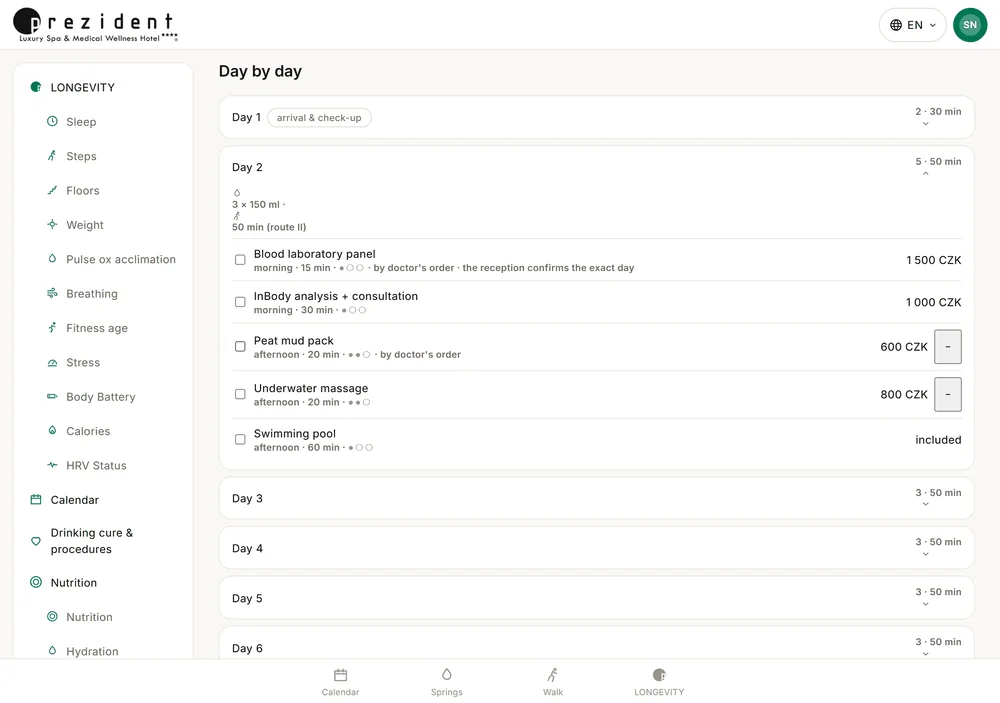
Arrival day is medical: the doctor's examination (30 minutes) and the drinking-cure prescription (15 minutes), no paid procedures at all, and a shortened walk. Day two is already typical: the blood panel and the body-composition measurement in the morning, a mud pack and an underwater massage in the afternoon, the pool, 50 minutes of walking and three visits to a spring.
Every seventh day is a rest day: one gentle procedure and the pool remain, everything demanding is taken out. For the demonstration guest that is day seven, with an aroma massage. The last day is short — the closing consultation and morning procedures before departure.
Day by day: day two is open — the blood panel, InBody, a peat mud pack, an underwater massage and the pool. Every item carries its slot, its length, its intensity dots and its price; arrival day above it is folded and labelled.×
The night loop and safety
The night arrives in the portal by itself and is compared not with somebody else's norm but with the guest's own average for this stay. The loop starts never before 06:00: the fleet of watches syncs on a half-hour round, and a correction made on an empty night would cancel a procedure for someone who is simply still asleep.
The strain flags. Heart-rate variability 15 % below the guest's own average, resting pulse 5 bpm above it, Body Battery below 40 of 100, sleep shorter than 6 hours or a sleep score below 60, a daily load 50 % above their own. Every threshold moves in the doctor's panel (the full list).
What the portal changes itself. The walk — 30 % shorter, but never below 20 minutes; an included heat procedure is dropped for the day, and the guest puts it back with a button.
What stays with the doctor. Paid procedures are, by default, only proposed: the reason is printed in the morning sheet. The hotel switches on automatic swapping of paid work separately, and even then no more than two items change in a day.
A swap is chosen by kinship. A demanding water procedure becomes a bath, a demanding massage becomes a gentle one (aroma massage, Indian head massage). The candidate must pass the guest's contraindications and must not repeat what already stands in that day.
The balneological reaction is an expected part of the course. The mud pack and the mud bath are heat procedures, and fatigue on the third or fourth day is normal. The portal does not cancel the course, it unloads the day: a shorter walk, and magnetotherapy, laser or the biolamp in place of heat.
Blood oxygen below 90 % at night is the one flag on the sheet that is not about tiredness: that guest is shown to the doctor before today's procedures.
Metal in a joint and pacemakers. The intake checkbox "pacemaker, metal implants or a joint replacement" removes magnetotherapy, electrotherapy, ultrasound, BEMER biostimulation, andullation and cryotherapy from the pool before the algorithm starts laying out days. The plus button will not accept them either, and says why. The course stays whole all the same: mud, sulphur baths, underwater massage, the hydrojet bed, paraffin, aqua gymnastics and the pool are untouched by that checkbox.
A history of cancer removes more: mud, magnetotherapy, electrotherapy, ultrasound, laser and traction. When contraindications leave less than 60 % of the slots the budget promised, the plan says plainly that the doctor will finish it at the first examination.
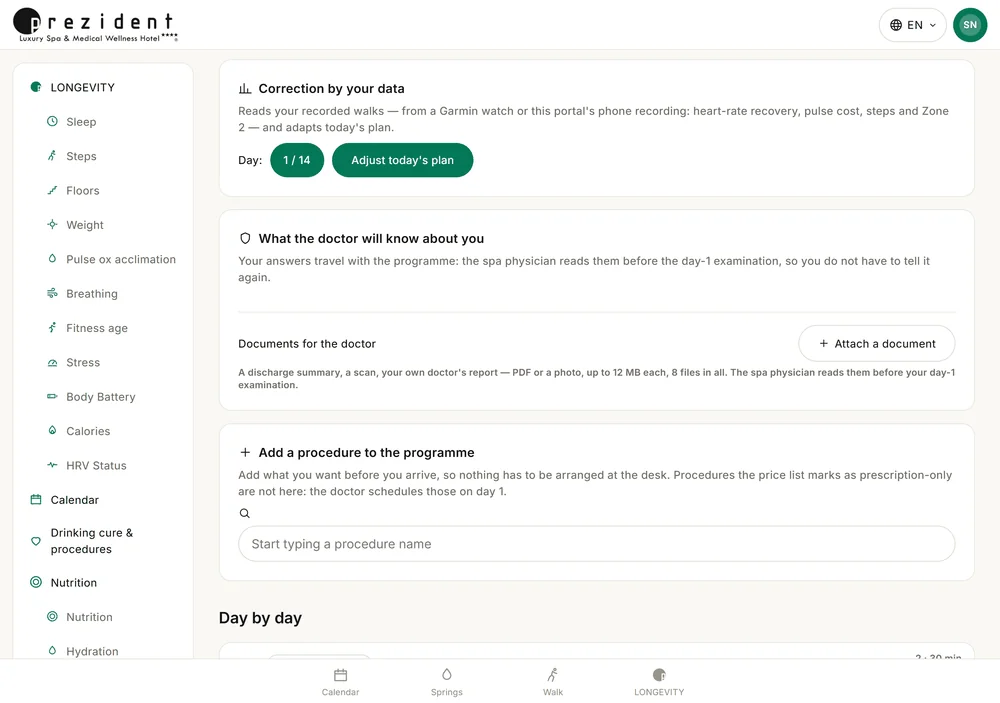
Correction by the guest's data inside the plan: the portal reads the recorded walks — heart-rate recovery, beats per kilometre, steps and zone 2 — and adapts today. Below it, documents for the doctor and the search a guest adds a procedure with.×
Who it suits and how to start
The programme is chosen by a two-minute questionnaire: the goal, the length of the stay, the pace, the budget and ten contraindication checkboxes. The answers become a draft plan, which the doctor signs at the day-one examination and amends as the stay goes on.
A stay shorter than five days is assembled too, but honestly marked as cut short: the mid-course consultation and the repeat body-composition measurement only appear from a certain length. The guest may have no watch at all — then the course runs as an ordinary spa protocol: the medical frame, the weekly ceilings and the rest days are all in place, and only the night correction and the tests are missing.
How long does the Joints & Mobility programme run?14 days by default, 5 at the minimum. A shorter stay is still assembled, but the plan marks the course as cut short.
Which procedures does it contain? The core is peat mud packs, sulphur baths, underwater and therapeutic massage, the hydrojet bed, magnetotherapy, aqua gymnastics and the pool. The extras are the Breuss massage, Thai massage, electrotherapy, ultrasound, laser, the mud bath, the biolamp, paraffin wraps for hands and feet, and spinal traction.
Can I take the course with a joint replacement? Yes, but without magnetotherapy, electrotherapy and ultrasound: the "metal in a joint" checkbox removes them from the plan automatically, and they cannot be added by hand either. Mud, sulphur baths, underwater massage, the hydrojet bed, paraffin and aqua gymnastics remain.
What if the mud leaves me exhausted? That is the balneological reaction, and it is expected. The portal sees it in Body Battery and heart-rate variability and unloads the day by itself: a shorter walk, and non-thermal procedures in place of heat.
Do I need a watch? No. Without one the course runs as an ordinary spa protocol; the watch adds the six measures, the three functional tests and the night correction of the plan.
Sources
Gait speed and survival: Studenski et al., 2011, JAMA.
Balneotherapy for osteoarthritis: Cochrane reviews.
Leg strength and sarcopenia: the EWGSOP2 criteria, 2019 — five rises slower than 15 seconds.
Balance and mortality: Araujo et al., 2022, British Journal of Sports Medicine.
The six-minute walk and VO2peak: Ross et al., 2010.
Steps and mortality: Paluch et al., 2022, Lancet Public Health.
The aerobic norm: WHO, 2020 — 150–300 minutes of moderate activity a week.